Get Full Government Meeting Transcripts, Videos, & Alerts Forever!
Get email alerts on the Basin Optimization Modeling topic
No spam. Unsubscribe anytime.
Board accepts Watermaster response to TAC on basin optimization yield modeling; staff disagrees on one TAC refinement
Summary
Staff presented preliminary numerical-modeling results for the Basin Optimization Yield Study and recommended approval of the Watermaster response to the Technical Advisory Committee; the board approved the response and staff said model uncertainty makes testing reduced in‑lieu volumes beyond the study scope unhelpful at this stage.
Agency staff presented the preliminary numerical modeling results used for the Basin Optimization Yield Study, which is intended to determine operating yield and ramp‑down rates so that sustainable yield and operating yield converge by the judgment's target year.
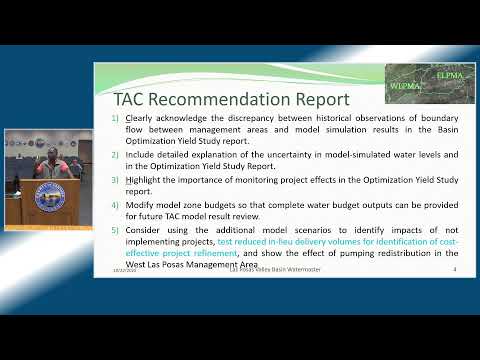
Staff said the board previously selected a preferred modeling approach and that Dudek (the agency's consultant) produced model runs that were reviewed by the Technical Advisory Committee (TAC). The TAC submitted five recommendations; staff agreed with four and disagreed with one TAC recommendation that called for additional testing of reduced in‑lieu delivery volumes to refine cost‑effective project identification.
Staff said that further testing of reduced in‑lieu volumes would exceed the study's scope and risk producing misleading results because of model uncertainty related to updated flow representations at the East–West basin boundary (Summit Swale). Instead, staff recommended using groundwater monitoring and existing infrastructure-based projects to inform near-term basin management while reserving further modeling refinements for later phases.
The board voted to receive and file the presentation and to approve the Watermaster response report to the TAC recommendation report. The agency will continue iterative updates to the Basin Optimization Yield Study (with opportunities for further modeling and monitoring) and will use the preferred alternative modeling approach for the next steps in basin management planning.