Get Full Government Meeting Transcripts, Videos, & Alerts Forever!
Get email alerts on the Curriculum Personal Finance topic
No spam. Unsubscribe anytime.
Springfield Township SD to add required personal finance; high school updates business electives
Summary
The Academic Affairs Committee reviewed revisions to high school business electives and a new personal finance requirement stemming from a Pennsylvania Department of Education mandate. Administrators previewed course outlines and asked the committee to move the courses forward for approval.
Dr. Damien Johnston, assistant superintendent for Springfield Township SD, told the Academic Affairs Committee on Oct. 6 that the district is preparing to implement a required personal finance course at the high school in response to a Pennsylvania Department of Education requirement.
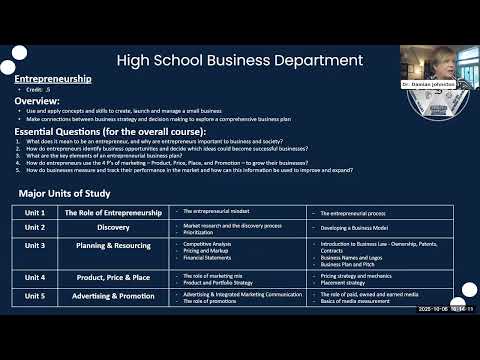
The change comes as the district presented a set of revised business electives—personal finance/financial literacy, introduction to business, principles of marketing and entrepreneurship—each structured as a half‑credit elective. District staff said the personal finance offering will shift from elective status to a graduation requirement beginning next school year under the PDE directive; officials said they are still determining where the course will be placed in the schedule.
The committee heard detailed overviews of each course. Dr. Johnston summarized the personal finance course as intended to “provide critical personal finance skills and make sure that our students are leaving high school with a solid understanding about spending, saving, risk, insurance, budgeting and some of those key ideas.” The course is organized into four units: values/habits/financial foundations, credit and managing debt, savings and investment, and career research; district staff said the course will use the district’s typical half‑credit structure.
Mr. Levin, the high school business teacher, summarized the introduction to business course: “the way it's structured is we start with financial—teach them a little bit of financial skills about how businesses look at their performance using the number of sales and margin,” then move into micro‑ and macroeconomic concepts and entrepreneurship. He described the principles of marketing course as an introductory, college‑style survey that covers the four P’s (product, price, place, promotion), with updated attention to digital media and social platforms. The entrepreneurship course asks students to develop a business plan and make an applied business strategy proposal.
Committee members confirmed the courses are semester‑length (one semester, meeting every other day under the district’s block schedule—90 calendar days with 45 course meetings), and they signaled support for moving the course proposals forward for formal adoption. Dr. Johnston said the materials shown are clickable and will be shared with the committee in the meeting minutes for further review.
Next steps noted during the meeting: staff will finalize placement of the personal finance requirement in the high school schedule and return to the committee with the full curriculum documents and implementation timeline. The committee also has a scheduled meeting Nov. 24 that will include additional curriculum updates.
Ending: The committee did not take a formal vote on the proposals on Oct. 6; members agreed to proceed with the curricular development and return curriculum documents and placement recommendations for future formal consideration.