Get Full Government Meeting Transcripts, Videos, & Alerts Forever!
Get email alerts on the Capital Planning topic
No spam. Unsubscribe anytime.
Finance commission approves Norwood FY26 capital plan, sets $2 million capital‑stabilization seed; members debate borrowing vs. free cash
Summary
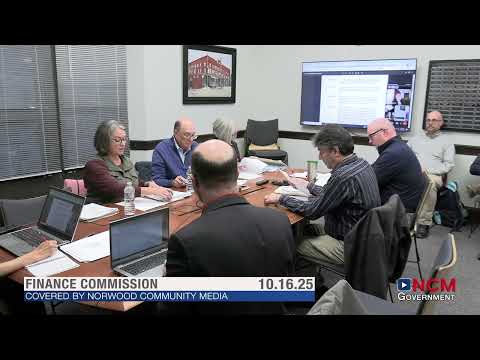
The Norwood Finance Commission voted Oct. 16 to approve the town's fiscal‑year 2026 capital plan and to place $2 million into a newly proposed capital‑stabilization fund, while members debated whether to fund projects with free cash or by borrowing.
The Norwood Finance Commission voted Oct. 16 to approve the town's fiscal‑year 2026 capital plan and to place $2 million into a newly proposed capital‑stabilization fund, while staff and commissioners debated whether to pay for projects with free cash or by borrowing.
Capital Outlay Committee Chair Bob Donnelly and staff presented the committee's FY26 recommendations. Assistant Town Manager Mike Rosen described the plan's projects and funding sources and answered commissioners' questions. Rosen told the commission the committee met several times with department heads and that the plan was vetted before it was presented to the Selectmen.
Key changes and projects discussed: - Elementary schools HVAC: A $250,000 study originally in the plan was removed; Paul Riccardi (facilities) and staff instead will have facilities staff assess elementary‑school electrical capacity in‑house and return in the spring with a targeted replacement program. Donnelly said Diorio Electric will produce a report on electrical needs at five elementary schools and coordinate with the light department. - Sidewalks and roadwork: The plan proposes continued multi‑year sidewalk investments; Rosen said recent work has completed many of the worst segments and that the plan would add more miles in FY26–FY28. - Fire and public‑safety equipment: Chief Bailey reported two ambulances entered service in October 2023 and carry more than 70,000 miles; a new ambulance was discussed with current unit costs in the $480,000 range. The commission heard that lead times for new ambulances exceed two years, so advance authorization is recommended. - Public safety building maintenance: Carpet replacement at the fire station will be staged in two batches to reduce operational disruption at a 24/7 facility. - Recreation/Civic Center kitchen: Recreation staff and Sam White described plans to replace appliances and some cabinetry; the project is budgeted at about $50,000, split $25,000 from the recreation revolving account and $25,000 from free cash; revolving funds are limited to program‑touching items (appliances) rather than building electrical or plumbing. - Tasers: The capital plan includes an ongoing $51,000 annual payment over eight years to retire a 2023 bulk taser purchase; Rosen said staff will reevaluate replacement strategy after that schedule ends in FY31. - Library and Town Hall needs: The capital plan includes a $2 million first‑phase project for the library to address water infiltration and critical MEP (mechanical/electrical/plumbing) items; staff and commissioners urged a town‑wide facilities plan so the town can prioritize major building investments and avoid piecemeal spending. - Land acquisition: The commission discussed a potential acquisition of the Kopsky Farm (820 Neponset Street). A tentative purchase price cited in the meeting was about $7.25 million; roughly $6.18 million of that figure was described as available from proceeds held for open‑space acquisition (Forbes estate proceeds). Two abutting properties, 814 and 816 Neponset, are separately appraised and were listed in the plan with a tentative combined price of about $1.8 million; commissioners deferred final action on the land articles pending appraisals and negotiations.
Financing and policy debate: Commissioners and Selectmen staff debated whether to finance projects with free cash or to borrow. Rosen recommended authorizing borrowing for several multi‑year projects (sidewalks, library facade, ladder truck) and using free cash for shorter, one‑time needs. Several commissioners expressed a desire to preserve free cash balances and to consider pension contributions and reserve levels when deciding whether to borrow.
Formal votes and next steps: - The Finance Commission voted to approve the FY26 capital plan as presented, listing free‑cash obligations of $2,109,500, a recreation revolving contribution of $25,000, general‑fund borrowing of $8,950,000 and enterprise‑fund borrowing of $5,000,000 (roll‑call recorded in meeting minutes). The motion carried on a roll‑call vote recorded in the meeting. - The commission approved placing $2,000,000 from free cash into a new capital‑stabilization fund (the draft policy will be revised and circulated to the Board of Selectmen and returned to the commission for review). Commissioners asked that language on the fund be clarified to state that the stabilization account "may" or "should" be used for capital projects when available free cash is insufficient or other financing conditions make borrowing undesirable; staff will revise the proposed policy language and circulate it for comment.
Why this matters: The capital plan directs more than $13 million in near‑term investments and establishes a capital‑stabilization fund intended to smooth capital spending and provide an alternative to borrowing in years with limited free cash or high interest rates. The plan includes high‑cost, long‑lead items (ambulances, ladder truck, library repairs) as well as recurring roadway and sidewalk work.
The commission will reconvene Oct. 30 to review funding‑source decisions and to finalize positions before the Special Town Meeting warrant is finalized.