Get Full Government Meeting Transcripts, Videos, & Alerts Forever!
Get email alerts on the Noxious Weeds Vegetation Management topic
No spam. Unsubscribe anytime.
San Miguel County vegetation staff report lower musk thistle coverage, discuss using cost-share to help private landowners
Summary
County vegetation control staff told the Citizens Weed Advisory Board they treated 419 acres in 2025, reported reductions in musk thistle on several sites and described a new five-year U.S. Forest Service contract; board members discussed whether county cost-share funds should also cover applicator labor for private-property treatments.
Julie Cole, lead manager for San Miguel County Vegetation Control and Management, updated the Citizens Weed Advisory Board on the department’s 2025 work on noxious weeds and discussed options to expand the county’s cost-share program to help private landowners pay for weed control.
Cole said county crews and contractors covered more than 53,000 acres during routine driving and visual assessments this year and that “the crew treated about 419 acres.” She said those treated acres reflected sites where active herbicide, mechanical or other treatments were necessary after assessment.
The nut graff: Cole told the advisory board that the increase in treated acreage and department workload this year is largely the result of a new U.S. Forest Service contract, not a sudden countywide surge in weeds. Board members followed the update with questions about the county’s cost-share program and whether the county should use existing funds to help pay applicators’ costs when private landowners seek assistance.
Most important details and background
Cole described yearly mapping and assessment work the department conducts on county roads, trails and on entities covered by memoranda of understanding, including the Town of Telluride, Mountain Village, the Telluride Airport and several gravel pits. She said work on the west end of the county is dominated by Russian knapweed and tamarisk, while the east end shows a larger variety of species.
On contracted work and grants, Cole said the department had a new contract with United Gravel in 2025, continued work with the Town of Mountain Village and Telluride Airport, and for the first time in 2025 held a U.S. Forest Service contract. She said the U.S. Forest Service agreement is a five-year contract valued at $50,000 in total and that the county contributes a share to each year’s work.
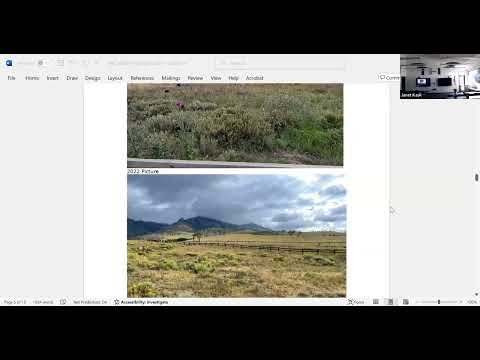
Cole described a two-week deployment by a conservation corps team funded in part by an America the Beautiful grant. That crew completed about three linear miles of tamarisk cutting and stump treatment in Dry Creek Basin; Cole said her own crew assisted for several days and documented before-and-after photo points.
On biological controls, Cole said the department released tamarisk beetles in Disappointment Valley in 2024 and has monitored the site; she told the board she has not seen more than roughly 10% defoliation and that the beetles have not produced sustained control.
Survey and cost-share discussion
Cole summarized results from a noxious-weed public survey posted online for several months. She reported the survey received about 42 responses and that roughly half of respondents did not know the county offers a cost-share program that provides herbicides at a 50% discount. On the question of whether San Miguel County should take enforcement action against landowners who do not control noxious weeds, Cole said about 63% of respondents favored county enforcement.
Cole reported a modest increase in the county cost-share fund but said the available amount was still small in practical terms, citing $704 as the recent increase she received for the program.
After the presentation, board members asked whether the cost-share could be used to cover applicator fees or to reimburse private applicators so the county would not directly compete with local businesses. Cole said that approach is possible, but warned the county should coordinate with local applicators so county-funded work does not undercut private contractors. She noted the county already tries to coordinate with a local applicator, Wes Rushing, and allows him to use county-purchased herbicides at the discounted rate when he is the applicator.
Implementation and next steps
Board members asked staff to bring the question of using the Board of County Commissioners’ cost-share allocation for applicator labor back to a future Weed Advisory Board meeting and to consult the commissioners on whether to reallocate funds. Cole said she will apply for the Colorado Department of Agriculture noxious-weed funding (the Noxious Weed Fund) when that application opens for 2026 and does not expect a decision until February or March; any state funds could be used to expand the county cost-share for herbicide purchases but would be contingent on receiving the grant.
Ending
The advisory board did not take any formal votes at the meeting. Members thanked staff for the update and asked staff to return with options on whether and how the county could use existing cost-share dollars to assist with applicator fees or reimburse private applicators. The meeting adjourned at about 4:43 p.m.