Get Full Government Meeting Transcripts, Videos, & Alerts Forever!
Get email alerts on the Superintendent Search topic
No spam. Unsubscribe anytime.
Green Bay school board, CESA 7 kick off superintendent search; board tweaks survey, interview plans
Summary
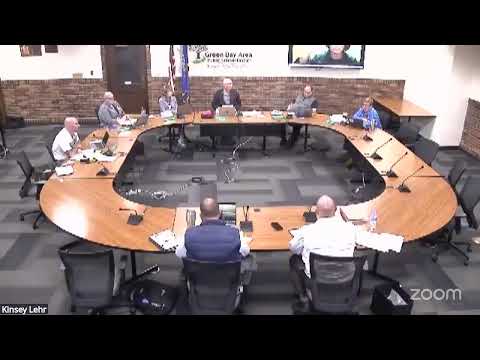
GREEN BAY, Wis. — The Green Bay Area Public School District board met in a special session Oct. 20 with consultants from CESA 7 to begin what CESA 7 described as “the kickoff, for the superintendent search.”
GREEN BAY, Wis. — The Green Bay Area Public School District board met in a special session Oct. 20 with consultants from Cooperative Educational Service Agency 7 (CESA 7) to begin what CESA 7 described as "the kickoff, for the superintendent search." Aaron Malcheski, agency administrator at CESA 7, presented a timeline, a draft job posting, community and staff survey plans, a focus-group schedule and a two-round interview structure for finalists.
The meeting focused on process and timing rather than final decisions. "This is kind of the kickoff, for the superintendent search," Malcheski said as he began the presentation. He told the board the materials they would use for the search — timeline spreadsheets, a draft posting, sample survey questions, focus-group protocols and interview structures — had been distributed by email and placed at members' seats.
Why it matters: The superintendent selection will set the district's executive leadership. Board members repeatedly pressed for clarity about how public input would be solicited and used, how staff feedback would be gathered and whether finalists would receive additional time with the board before a hiring decision.
CESA 7 timeline and job-posting materials CESA 7 presented a full-process timeline and described opportunities for both open work sessions and closed sessions tied to candidate prescreening and interview-question development. The materials included two target interview dates listed in the packet as "02/24/2526" for first interviews and "03/04/1956" for second interviews; CESA 7 said those dates came from working backward from the board's desired pacing and would be refined in follow-up materials.
Malcheski told the board that district legal counsel is reviewing the superintendent contract so the document would be vetted before any final offer: "I communicated with the district's legal counsel to review the superintendent contract," he said.
Survey design and public engagement CESA 7 proposed separate survey instruments for staff and for the community (which includes students). "We would have at least 2 surveys based on the makeup that we have right here. So staff would have 1, and then the community 1," Malcheski said, adding that survey questions would be targeted by respondent type (for example, staff subgroups and community members with or without students).
Board members debated how to collect priorities on candidate characteristics. Some members favored asking respondents to select a top three for traits; others supported a stack-rank or drag-and-order control that would put options into a strict order. Malcheski said CESA 7 would test a stack-rank control and return an example for the board to try before the survey is final.
Board members also asked CESA 7 to add or clarify demographic answer choices. "In past surveys ... we often see a really strong representation from grandparents," Board Member Laura said, urging a separate option for grandparents or other family members. Malcheski suggested grouping options so the data remain analyzable and agreed to adjust the demographic fields.
Focus groups and outreach CESA 7 outlined a schedule of focus groups and community events intended to supplement survey responses. The consultants recommended the CAFE-style small-group approach (rotating poster tables with short discussions). Board members asked CESA 7 to expand outreach to specific community groups not on the draft list, including Hmong community organizations, the Somali association (COMSA), Casa Alba and Oneida representatives, and other neighborhood or labor groups.
"Make sure that every choice is differentiated from other choices clearly," Board President Lyerly said, asking CESA 7 to reduce redundant items in trait lists so survey responses yield clearer signals.
Interview structure, advisory committee and prescreening CESA 7 recommended a three-part first-round rotation for each candidate: a board interview, a mock public-relations scenario (to simulate media/community engagement) and an interview with an advisory committee. Malcheski said that advisory committee members would score candidates electronically (typically 1–5 on a rubric) and that those scores would be shared with the board as aggregated feedback, not as binding votes.
"We'd be able to bring those scores and show you aggregate scores of that committee and how they scored each candidate by, you know, their highest point gatherer," Malcheski said.
Board members discussed advisory committee composition and oversight. Several members said the committee should include staff across levels (elementary, middle, high), support staff and community representatives; one member asked that all board members have a role deciding the committee's membership. Malcheski said the board would receive a proposed composition for approval once consultants and district staff fleshed out logistics.
For second-round finalist days, CESA 7 proposed a "day in the district" with site visits, candidate interactions with administrators and community groups, and a working dinner with the board held on-site so the board could conduct a substantive interview. Board members emphasized preserving time for meaningful interaction with finalists and suggested splitting large staff/public meet-and-greet blocks so staff voice is not crowded out.
Prescreening: CESA 7 described a prescreen step after applications close in which candidates would take part in a brief recorded video or Zoom session; transcripts and scored responses would be provided to the board as part of the packet for narrowing finalists.
Board comments and next steps Many board members urged blocking calendar time now for interviews and penciling in extra dates to allow additional finalist interaction if needed. "I would like to just hope that we can, if needed, spend a little bit more time with them," Board Member Laura said. Board Member Alex and others supported penciling in those extra windows to increase the chance finalists could be scheduled.
CESA 7 took several follow-up assignments: (1) test and return a sample stack-rank survey control so the board can experience that input mechanism, (2) shorten and differentiate trait lists in the survey for clearer data and (3) finalize outreach lists and proposed advisory-committee composition. Malcheski said CESA 7 would also provide examples of the electronic scoring tool and sample transcripts from prescreen interviews.
No final votes or hiring decisions were taken at the meeting. The board concluded with plans to review refined materials at upcoming meetings and to hold action items on the posting and survey at a subsequent meeting.
What to watch next: CESA 7 will return a refined survey and a proposed advisory-committee list; the board requested the scheduling hold days for first- and second-round interviews while the timeline is finalized. CESA 7 said it would aim to make survey materials available for board review within the week before a planned posting window.