
Public commenter raises concerns about special‑education settlements; district says settlements draw on special‑education line item
Get AI-powered insights, summaries, and transcripts
Sign Up Free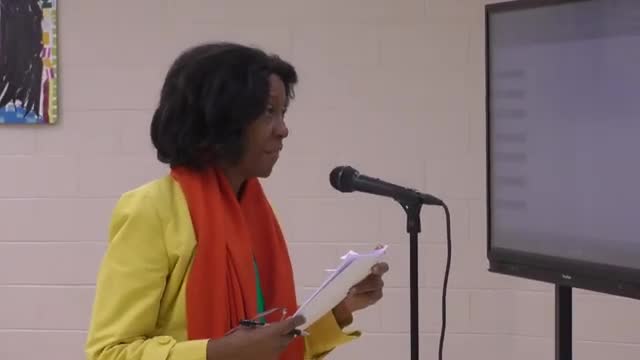
Summary
During public comment Jean Arnold asked whether the district budgets for settlements tied to special education and requested more information about two agenda items listed with dollar amounts; district officials said settlement payments come from the special‑education line item and a special‑education audit is forthcoming.
A member of the public at the Oct. 23 Chester‑Upland receivers meeting asked whether the district budgets in advance for special‑education settlements and requested more detail about two agenda items that list financial figures.
“Thank you. My name is Jean Arnold. I'm in 2601 McCarrey Street. I have it a comment about 8 5 ... I'm concerned that we are escalating those numbers again and whatever we need to do to bring those numbers down and to be compliant,” Arnold said during the public‑comment portion of the meeting.
Arnold cited agenda items she interpreted as settlement payments and noted six related items in total on the agenda. She asked whether the district anticipates settlement costs in the budget and whether that signals noncompliance with IEPs. The district responded that settlements are paid from the special‑education line item rather than from a separate “settlement” budget. “No. We don't. But you understand? We don't budget for settlement,” a district official said.
Clarifying details provided at the meeting included that the district is conducting a special‑education audit that will be presented to the public two months after the audit is conducted. Arnold also asked specifically about agenda items she identified as A15 and A16; the meeting transcript records a reference to $48,000 for one item and up to $58,000 for another, and mentions six students associated with one of the items.
The district said it could not disclose details of negotiated agreements in public when confidentiality applies, and that some employees had waived their right to public hearings in personnel matters. The board directed staff to follow up with additional information on the services associated with the items when permissible.
The board recorded no change to the agenda based on the public comment; the items referenced by Arnold remained listed as budgeted in the packet and were later approved as part of the meeting’s education and business agendas.
The public comment and official responses focused on process clarifications: the source of funds for settlements (special‑education line item), the forthcoming special‑education audit and limits on public disclosure for confidential agreements.