Get Full Government Meeting Transcripts, Videos, & Alerts Forever!
Get email alerts on the Sales Tax topic
No spam. Unsubscribe anytime.
Port Hueneme Measure U revenue down as cannabis sales fall, consultant says
Summary
Brett, a principal consultant with HDL, told the Port Hueneme City Measure U committee that the city’s combined sales and transaction-use tax receipts are down compared with the same quarter a year earlier and that the decline is driven largely by falling cannabis-related business and shifts in online sales allocations.
Brett, a principal consultant with HDL, told the Port Hueneme City Measure U committee that the city’s combined sales and transaction-use tax receipts are down compared with the same quarter a year earlier and that the decline is driven largely by falling cannabis-related business and shifts in online sales allocations.
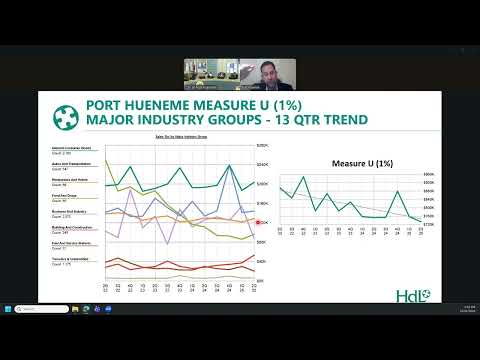
HDL’s analysis, presented at the committee’s quarterly meeting, found Port Hueneme’s second quarter 2025 combined tax receipts were about 8% lower than second quarter 2024 while the state overall was up roughly 0.5% and Ventura County about 1.2%. ‘‘The pools are typically the second or third largest group in almost every agency throughout the state,’’ Brett said, describing how the AB 147 and the Wayfair-related changes increased online-sales pool allocations beginning in 2019 and 2020.
Why it matters: sales tax is the city’s largest revenue source. City staff said sales tax makes up about 23% of general fund revenue and that Measure U alone accounts for roughly 11% of the general fund. HDL told the committee Measure U receipts for fiscal 2024–25 totaled $3,000,001.76 and that the 2025–26 projection is a decline of almost 1%.
HDL explained two separate allocation rules that affect Port Hueneme: the Bradley-Burns local sales tax portion follows the direct point of sale, while transaction- and use-tax (Measure U) allocations follow delivery location. ‘‘Automobiles are dependent—the transaction and use tax that’s generated on automobiles is dependent on where that vehicle is registered,’’ Brett said, contrasting dealership point-of-sale allocations with the district tax that flows to the vehicle’s registration jurisdiction.
The consultant described eight major industry groups the firm tracks (autos and transportation; building and construction; business and industry; food and drugs; restaurants and hotels; general consumer goods; fuel and service stations; county pool allocations). In Port Hueneme, food and drugs had been the largest group in recent years but has fallen in ranking largely because cannabis-related businesses—a subset of food and drugs—have declined. HDL reported 17 cannabis-related business permits counted in the city, a number that had recently fallen further due to permit activity.
HDL noted offsetting trends: restaurants and hotels and general consumer goods have gained relative share, and some diversification has occurred. The consultant also said fulfillment centers were an outsized driver of volatility: where fulfillment centers are located or where goods are delivered can cause large quarter-to-quarter swings in both Bradley-Burns and transaction-use tax pools. ‘‘If you see big spikes, it’s more likely to be in those business types that make up the biggest percentage of that industry group,’’ Brett said.
Committee members pressed staff and the consultant on local policy levers. Committee member James Importante asked about ‘‘leakage’’—residents shopping outside the city—and ‘‘capture’’ opportunities. Importante also flagged possible near-term impacts from federal-level disruptions to SNAP/CalFresh benefits and said those funding pauses could reduce purchases in some local stores.
Committee member Beth Williams asked about spikes in autos and transportation and about vacant retail sites such as a closed Rite Aid and the planned Sprouts. Brett said agency-level intel (which HDL gathers from city staff) is factored into forecasts when known; otherwise statewide trends are used.
City staff provided a brief budget clarification when asked: ‘‘sales tax is about 23% of our general fund revenue. And if we just take Measure U out of that, it would be about 11%. But sales tax is our highest revenue source,’’ the staff member said. Staff also confirmed they have an electronic copy of the presentation and that HDL had shared results with staff during the day.
Outcome: the committee received and filed the presentation; no vote was required. The committee set its next quarterly meeting for Jan. 28, 2026.
Notes and forward look: HDL’s statewide forecast anticipates slow recovery, with growth assumptions of about 2.5% in later years; the consultant said statewide levels may not recover to pre‑fiscal‑year‑2023–24 levels until late 2026–27. Local recovery for Port Hueneme will depend on business mix, new tenants for vacant sites and the local share of county pool dollars tied to online-sales delivery locations.