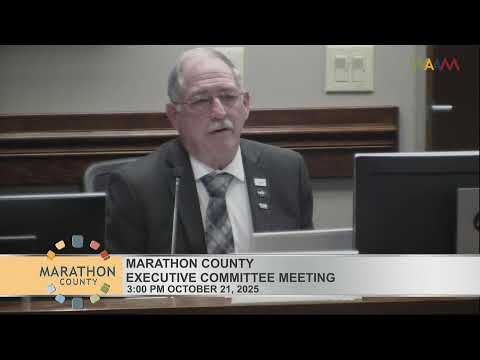
Marathon County reviews FEMA-funded feasibility study and options for aging ice arena
Loading...
Summary
County staff presented a FEMA/BRIC-funded feasibility study and options for the Marathon County Ice Arena, including costs for a new two-sheet year‑round facility, phased rebuild, or targeted upgrades; administrators asked the Executive Committee to advise a decision-making process and possible fundraising targets.
Marathon County Executive Committee members received a feasibility study and planning briefing on the Marathon County Ice Arena and the county’s decision-making options for the facility’s future.
The presentation, led by Parks and Recreation Director Jamie (name not specified), summarized recent repairs, user-group needs and usage, a FEMA BRIC (Building Resilient Infrastructure and Communities) grant-funded feasibility analysis, and four high-level options ranging from targeted system upgrades to construction of a new two-sheet, year‑round arena. County Administrator Lance (last name not specified) framed the next step as a board-driven decision about whether the county will remain in the ice‑delivery business and, if so, what level of capital commitment it will pledge.
The study showed the county’s existing facility was built in stages (Rink 1 in 1974, Rink 2 in 1986), that many systems were beyond expected useful life, and that the county installed a temporary ice‑mat system this year to restore Rink 2 after a refrigeration failure. Jamie said, “As of yesterday, we had our first rentals on Rink 2. We’re completely up and running for the season on both Rink 1 and Rink 2.”
Why it matters: the arena serves three high‑school teams, youth hockey organizations with hundreds of players, adult leagues, figure skating and public skating; upgrades or replacement could affect community recreation, regional tournaments (heads in beds), and long‑term county budgets.
Options and cost estimates
- Option 1 — New two‑sheet, year‑round arena with a safe room (design options included): the consultant’s order‑of‑magnitude estimate was about $54,000,000 (including design, contingency and escalation assumptions). That facility would include one sheet with 1,200–1,500 spectator capacity, 10 team rooms, larger lobby, concessions and dedicated meeting/dry‑land space.
- Option 2 — Rebuild Rink 1 as a year‑round sheet and renovate/upgrade Rink 2 (retain current site): higher functionality on the existing site; the consultant’s phase cost estimate for this approach was about $34,000,000.
- Option 3 — Targeted upgrades to the current two‑sheet facility (replace refrigeration and floor piping, roof upgrades, cooling tower, other deferred capital): lower cost, consultant estimate roughly $7,000,000–$8,000,000 for critical infrastructure work, but retains seasonal ice and limits long‑term expansion and shoulder‑season programming.
- Option 4 — Cease county operation of an ice arena when facilities fail: results in loss of a county‑operated community resource and significant displacement pressure on local user groups; committee members said there is currently no equivalent facility nearby with the capacity to absorb the county’s entire user base.
The feasibility study team also modeled operations and projected that a facility configured with one year‑round sheet could approach nearly break‑even operating results after several years of ramping programming, though consultant revenue projections did not include debt service. The consultant estimated an approximate $3,000,000 annual regional economic impact from tournaments and related spending.
Funding, process and stakeholder expectations
County staff and supervisors emphasized the funding and process questions are policy decisions for the full County Board. Administrator Lance said the board must answer three threshold questions: (1) do we want to remain in the ice‑delivery business long term; (2) if yes, what level of capital and operating commitment will the county pledge; and (3) how should the board structure its decision process (standing committees, a board‑level task force, or another format)? Lance noted a prior BRIC/FEMA construction grant program the county hoped to use for construction has been suspended for the funding cycle, though design applications are being retained by the program administrator.
Several supervisors urged a community engagement and fundraising approach if the county intends to seek partial local matches. Drawing on precedent, one supervisor recalled the warm‑water therapy pool process where the board conditioned county bonding on community fundraising targets, noting that user groups and donors often want a clear county pledge before committing.
User needs and study process
The consultant’s program was driven by detailed input from every major user group and two public meetings. Jamie said the study’s program reflects user group needs (locker rooms sized to team rosters, tournament team‑room counts, skate programming needs). “When you ask the users what they want, they’re all going to say Option 1,” Jamie told the committee, but added that the county and community must evaluate the cost and feasibility.
Immediate repairs and time horizon
Staff described the recently installed ice‑mat system as a multi‑year stopgap (7–10 year expected life, with seasonal installation and removal). The mat purchase and associated refrigeration room work were approved earlier this year by the County Board (purchase/implementation already completed), and staff said the mat has restored regular use for the current season. Committee members were advised that the mat buys planning time but does not eliminate the need to choose a long‑term path within a limited timeline.
Next steps suggested to the Executive Committee were: direct staff on the preferred decision process (standing committee route vs. board task force), indicate whether the county should commit to remaining in the ice‑delivery business, and — if the county is willing to share capital risk — set a county pledge target to inform community fundraising or a public‑private partnership effort. Lance asked the committee for reaction to a draft decision‑making framework and indicated the item will return to the committee for further direction.
Speakers: Parks and Recreation Director Jamie (presenter), County Administrator Lance (presenter), and multiple county supervisors who participated in discussion including Supervisor Robinson, Supervisor Arstead, Supervisor Drabek, Supervisor Maske, Supervisor Morash/Marash and others.
Ending: The committee did not take a formal vote on a preferred option; members asked staff to place the item on a future agenda with recommendations on process and potential funding scenarios so the full board can weigh capital commitments and timeline.