Get Full Government Meeting Transcripts, Videos, & Alerts Forever!
Get email alerts on the Water Sewer Standards topic
No spam. Unsubscribe anytime.
Villa Rica updates water and sewer standards and weighs fire-hydrant color policy
Summary
The Villa Rica City Council approved technical updates to water and sewer development regulations intended to standardize equipment and maintenance. Councilors discussed whether new fire hydrants should use a red body or follow NFPA color-coding (yellow bodies with bonnet colors indicating flow).
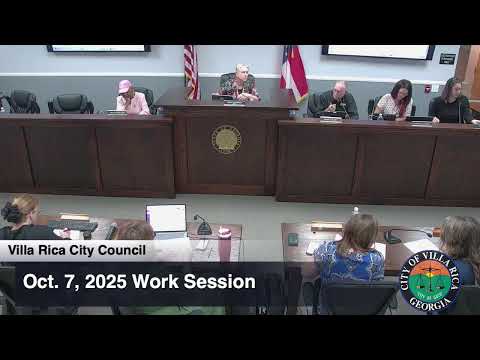
Villa Rica — The Villa Rica City Council on Oct. 7, 2025, approved revisions to the city’s water and sewer development regulations that standardize pipe, pump and lift-station components and considered guidance on how new fire hydrants should be painted.
The changes, introduced by Interim Deputy City Manager and Utilities Director John Bain, set material and equipment standards for new development. “The city will only accept ductile iron pipe manufactured in The United States,” Bain said during the work session, and he listed lining and coating requirements the city will require for ductile iron pipe in new projects. Bain told the council the updates are intended to standardize equipment across the system so maintenance and inventory are simpler for staff.
The revisions affect wastewater and water sections of the development regulations. Among the wastewater provisions Bain described: specification of preferred pump and control-panel manufacturers (“Pump shall be manufactured by flight, soleser, or approved equal” and “Control panel shall be manufactured by Amtech, STACON, or flight,” as presented to council); a requirement that standby generators or dry-prime pumps have a minimum 200-gallon fuel capacity; and a minimum five-year manufacturer warranty for those units. Bain said the city has 32 wastewater lift stations, each with at least two pumps, and the standards are meant to reduce field variability and maintenance burden.
Bain also proposed stricter design elements for wet wells and electrical systems, including stainless-steel vents and chains, three-phase electrical service for lift-station controls, and level-detection systems combining a transducer with sealed float switches for alarm conditions.
Councilors focused most of their questions on the city’s proposal for fire hydrant painting in new development. Bain said his recommendation was to paint new hydrants red for the body while painting the bonnets (the top portion) according to NFPA color codes that indicate expected flow rates. “The recommendation presented in this presentation is for the hydrants to be painted red, but for us to paint the bonnets of the hydrant based on NFPA codes and standards,” Bain said, explaining the bonnet color would help firefighters identify whether a hydrant was out of service or the approximate flow available.
Council members offered differing perspectives. Councilman McCoy said he worried red bodies might be harder to see in some settings: “Red tends to blend in more than the yellow or the silver,” he said, adding that visibility at night matters. Councilman Carter noted the NFPA guidance Bain showed emphasizes a yellow body with bonnets colored by flow: “The code — the NFPA code — shows a yellow hydrant with a colorful bonnet,” Carter said. Bain told councilors the city could adopt the NFPA color scheme if they preferred and noted hydrants currently on systems owned by Carroll County or the Douglas County Water and Sewer Authority would retain those agencies’ painting conventions.
Bain emphasized the recommendation applied to new hydrants installed by the city’s utility system and would not immediately repaint existing hydrants: the city would “go back over time and as we maintain our existing hydrants” to bring them up to any new standard.
The council approved the development-regulation changes as a consent item (consent item No. 3). Bain said the standards reflect what crews already use in the field and are intended to streamline maintenance and procurement.
Next steps: staff will incorporate the adopted language into sections 400 (wastewater) and 500 (water) of the city’s development regulations and apply the hydrant-painting convention to new development projects; the schedule for any retrofit of existing hydrants was not specified during the meeting.