Get Full Government Meeting Transcripts, Videos, & Alerts Forever!
Get email alerts on the Education Stem topic
No spam. Unsubscribe anytime.
Students from Freetown-Lakeville show engineering, robotics and science projects
Summary
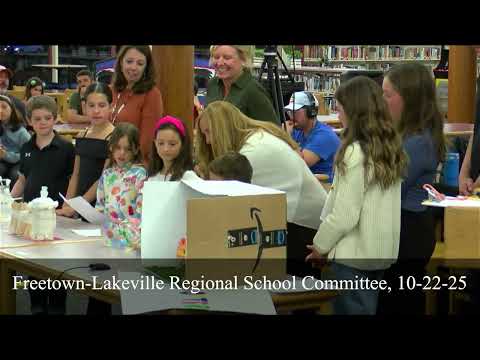
Students from elementary through high school presented hands-on STEM projects including balloon cars, habitat redesigns, bucket towers, robotics and 3-D printed mechanisms during the Oct. 22 Freetown-Lakeville Regional School Committee meeting.
Freetown-Lakeville Regional School Committee members heard a series of student presentations Oct. 22 showcasing hands-on work from STEM Week across the district, from first-grade balloon cars to high-school robotics and 3-D printed mechanical devices.
The presentations opened with first-graders from Freetown Elementary describing balloon-car projects. “Our favorite part of the project was making it with friends because it is fun,” said Robert D'Souza Jr., a first-grade student, as classmates demonstrated bottle-cap and CD wheels they used on their cars.
At Gray’s Elementary, third-graders described a literacy-linked engineering assignment. “Our STEM project was building a fence. We learned that engineers need to plan their work before they build,” said a third-grade presenter, Athena Duquette. Fourth- and fifth-grade students detailed bucket-tower and newspaper-structure challenges, emphasizing teamwork and testing to improve load-bearing designs.
Middle-school teams described redesigning a habitat for North American river otters; students said research and testing were key. “This project taught me how science, math and creativity work together,” one middle-school presenter said.
At the high school level, robotics and engineering students showed more advanced projects. Lex Eaton, a student in the robotics program, described a VEX-built robot programmed to play a version of freeze tag: “The coding aspect…you have to give yourself five lives, and you have to wait five seconds every time you're tagged.”
Engineering students demonstrated 3-D printed parts and mechanical linkages. One student explained switching printing material from ABS to PLA after parts failed to fit, then reprinting successful components and assembling a mechanism that converted rotary motion into a sliding (piston-like) movement.
Terry Fleming, the district’s director of curriculum and instruction, introduced the presenters and praised the district staff for building the week’s activities into classroom instruction. Fleming said the events combined engineering principles with literacy and public-speaking practice across grade levels.
The presentations illustrated the district’s multi-level approach to STEM instruction — starting with simple design challenges in elementary grades and progressing to coding, 3-D printing and systems design at the high school.
Committee members thanked students and staff for the demonstrations and noted the value of community visibility for school programs.