Get Full Government Meeting Transcripts, Videos, & Alerts Forever!
Get email alerts on the Conservation Programs topic
No spam. Unsubscribe anytime.
Glendora highlights outreach, turf-replacement incentives and regional dashboard planning
Summary
Staff reported outreach, workshops and a new co-funded regional dashboard project to map landscape water use; commissioners voted 5-0 to receive and file the conservation update and asked staff to continue program promotion and to return with the urban water use objective implementation plan next year.
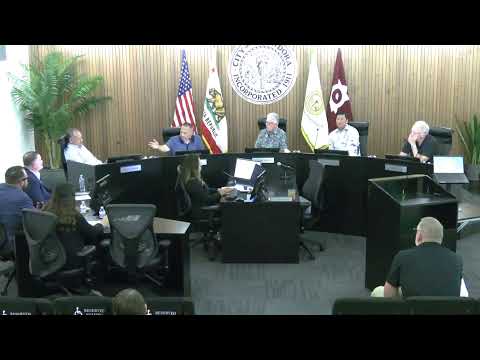
Senior Management Analyst Russell Ackerman presented the Water Conservation Program update for the first quarter on Oct. 21, describing public outreach, school poster entrants, workshops and a regional data project intended to support the city’s urban water use reporting.
Ackerman said staff promoted the Consumer Confidence Report, led state-mandated lead-and-copper sampling outreach, and conducted public events including National Night Out and the Flashback Car Show. He said staff introduced an engagement activity teaching residents how to read meters, developed a brochure for teachers, and will distribute materials to local classrooms in mid-November.
On incentives and regional partnerships, Ackerman said the city is promoting Metropolitan Water District (MWD)–funded programs: the residential turf removal program, a professional landscape-design rebate (an extra $500 for a qualified designer and $500 for a licensed contractor under certain conditions), and water-efficient device rebates with additional local match funding. He noted a city contribution on top of MWD’s $3-per-square-foot turf incentive and said commercial properties can now receive up to $7 per square foot in the updated MWD commercial turf rebate program.
The commission also heard that the city and 3 Valleys Municipal Water District signed a memorandum of understanding to co-fund a regional water-use-efficiency dashboard, using aerial imagery and land-use classification to identify nonfunctional turf and support future urban water use objective reporting. Ackerman said staff will develop the state-required urban water use objective plan and present it next year. He explained reporting rules presented by staff, including an alternative compliance pathway tied to a 2 percent per year per-capita reduction and certification to the AWWA/A4E (American Water Works Association and Alliance for Water Efficiency) standard.
Commission response: Commissioners asked about program participation and budget. Ackerman said WaterWise consulting participation is strong for home evaluations and leak detection; turf-removal activity is seasonally low but expected to increase in planting season. He said the conservation budget for the program is approximately $600,000 for the year, that co-funding dollars are allocated, and that many program funds are committed though not yet spent. The commission voted 5-0 to receive and file the conservation update.
Ending: Staff said it will continue outreach, distribute teacher materials, promote rebates and return next year with the urban water use objective plan and further participation data.