Get Full Government Meeting Transcripts, Videos, & Alerts Forever!
Get email alerts on the Public Health Budget topic
No spam. Unsubscribe anytime.
JFAC reviews Public Health Services budget; lawmakers weigh restoring ongoing programs and data modernization funding
Summary
The Joint Finance-Appropriations Committee heard a broad briefing on the Division of Public Health Services budget, including proposed restorations of previously cut ongoing programs, federal ARPA/CARES carryover projects for data modernization and WIC, and a governor's rural physician incentive initiative.
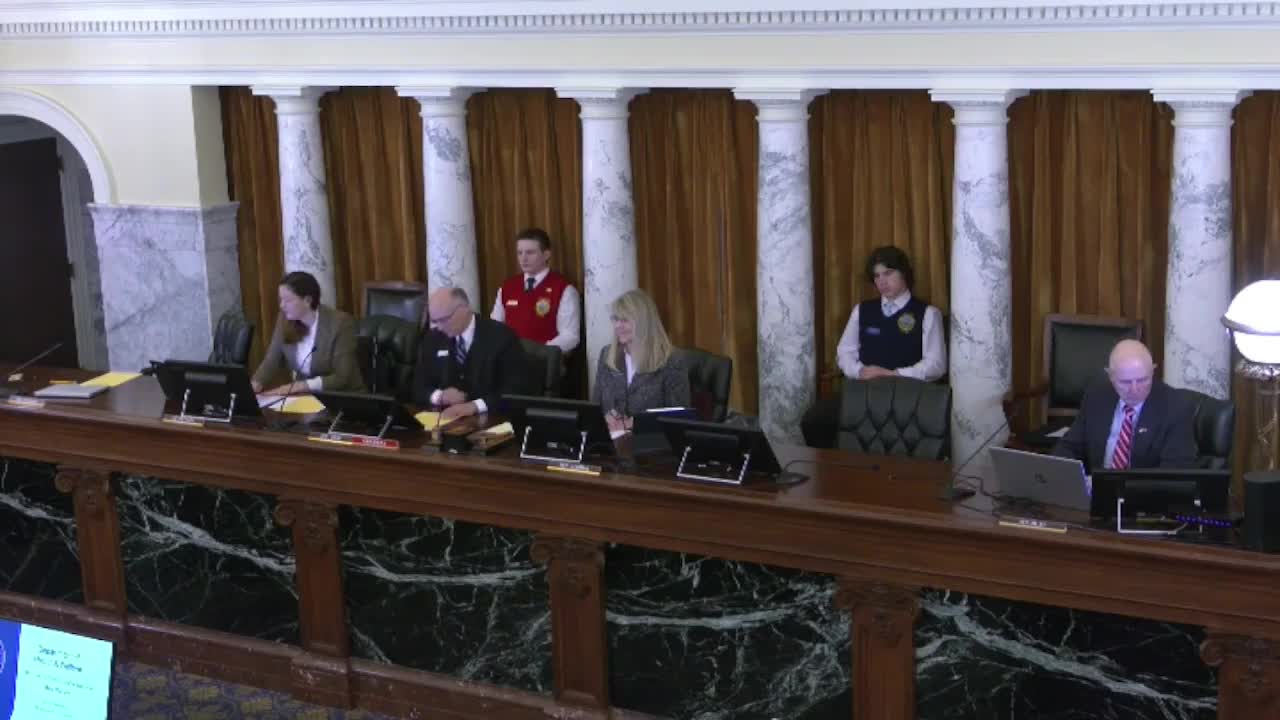
The Joint Finance-Appropriations Committee on an unspecified date heard a detailed presentation on the Department of Health and Welfare’s Division of Public Health Services budget, focusing on requests to restore ongoing program funding, pay for one-time data modernization work funded by federal carryovers, and expand several prevention programs.
The briefing, led by Keith Bybee, division manager of budget policy analysis, and Department Director Alex Adams, outlined that the division’s FY2025 appropriation was $164,020,000 and that the department’s FY2026 request was roughly $154,000,000 — a reduction the director described as “about $10,000,000 out of the budget or a 6% reduction year over year.” The division asked to reverse several prior moves that reclassified ongoing programs as one-time funding and to restore a number of programs to ongoing status.
Why it matters: the Division of Public Health Services funds immunizations, vital records, laboratory testing, emergency medical services (EMS), suicide prevention, WIC, HIV and hepatitis prevention, diabetes and chronic disease programs, and other prevention and preparedness efforts. Changes to ongoing funding levels or the state’s willingness to fund one-time modernization projects will affect local public health districts, clinics, and services relied on statewide.
Key details from the presentation
- Structure and trend: Public Health Services administers five program areas including physical health services, EMS, laboratory services, suicide prevention, and health care policy initiatives (including the State Healthcare Innovation Plan, SHIP). The division reported 256.52 full-time-equivalent positions established, with four vacancies as of Aug. 31, 2024. The FY2025 appropriation of $164,020,000 followed earlier CARES Act and ARPA inflows that inflated prior-year appropriations and spending.
- One-time federal and ARPA-related requests: The division listed roughly $8,752,500 in one-time, largely federal-funded requests that the governor recommended. Items described included public health infrastructure grants to bolster workforce hiring and retention; medical education loan repayment support for clinicians serving Health Professional Shortage Areas; vital statistics data modernization tied to CDC/NCHS grants; WIC system modernization; and a multi-part data modernization effort to improve data exchange and transparency.
- Ongoing restorations: The department requested $20,846,300 in ongoing restorations (the governor recommended $21,464,500). Representative items and amounts discussed by staff included: - Suicide prevention: $1,807,700 general fund and $195,000 federal funds to restore the program established by the legislature in 2016. - Drug overdose prevention: restoration of 4 FTE and $2,820,200 ongoing. - Refugee health screening: 1.5 FTE and $991,000 ongoing to restore refugee screening services in Boise and Twin Falls. - Alzheimer’s and dementia-related program: $275,200 ongoing. - Fit and Fall Proof (community exercise program for older adults): $140,000 ongoing. - Diabetes, HIV prevention, oral health workforce, and integrated hepatitis surveillance: a series of restorations with amounts noted in the budget book (diabetes $1,063,700; HIV $957,300; oral health workforce $379,600; hepatitis $599,200). - WIC / Women, Infant and Children program: staff said the request included restoring ongoing support; a figure of $6,944,600 ongoing was described for WIC-related work.
- Immunization assessment and vital records: staff described an immunization assessment fund request (transcript referenced both a $22.5 million figure in context and a $2.5 million ongoing request from dedicated funds specifically for the Idaho immunization program). The Bureau of Vital Records requested $150,000 ongoing from dedicated funds for vital records operations; staff noted more than 100,000 records processed annually.
- Home visiting and rural physician incentives: the budget book includes $725,900 ongoing (federal funds) for home visiting services to high-need counties and a governor’s initiative of $500,000 general fund for a rural physician incentive/medical education loan repayment program aimed at clinicians in federally designated Health Professional Shortage Areas.
Quotes and attribution
- "I'll be happy to answer questions, but I'm just gonna punt on all of them," Keith Bybee said to the committee after presenting a complex set of budget materials. - Director Alex Adams summarized the budget exercise to the committee: "I would characterize it as a healthy exercise ... it gave us a chance to get about $10,000,000 out of the budget or a 6% reduction year over year."
Questions and concerns raised by committee members
Committee members pressed for more detail on data modernization spending and asked for follow-up materials and spreadsheets. Senator Cook requested documents detailing what the department has already spent on system modernization before approving additional funds; Director Adams said staff would provide a summary. Several lawmakers asked whether programs might be better administered in other agencies (for example, moving certain prevention programs or EMS bureaus), and Adams and Division Administrator Elke Shaw Tullock said they were open to conversations about structural fit if transfers improved mission alignment.
Clarifying notes and limits of authority
Committee members also debated whether certain programs are appropriately housed in the Department of Health and Welfare (for example, the Project ECHO funding and the Office of Accreditation and Planning). Director Adams said accreditation is voluntary and that removing the accreditation status would not generally affect federal funding, but removing positions that drive performance measurement could affect the division’s ability to produce program results.
What’s next
Committee members asked for additional documentation on prior ARPA and data modernization spending, and staff agreed to circulate more detailed materials. Lawmakers signaled continued interest in preserving certain prevention and workforce programs while scrutinizing one-time federal carryovers and the return to an ongoing funding baseline. No formal committee votes or motions on specific budget items were recorded in the transcript excerpt provided.
Ending note
Committee members and agency staff framed the discussion as part of a larger, multi-year effort to rebalance the division’s budget after temporary pandemic-era funding. Lawmakers repeatedly requested follow-up materials on system modernization, service outcomes, and how restored ongoing funding would be measured.