Hinckley forum highlights human right to subsistence; speakers say legal remedies remain limited
Loading...
Summary
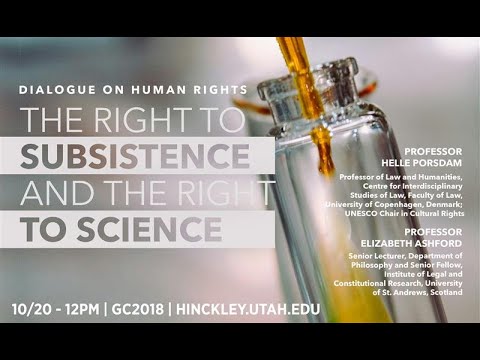
At a University of Utah Hinckley event, Professor Elizabeth Ashford and colleagues discussed the right to subsistence—basic food, water, shelter—and participants pressed for remedies, with former Salt Lake City mayor Rocky Anderson asking where enforceable relief exists locally.
Professor Elizabeth Ashford, a senior lecturer in philosophy at the University of St. Andrews, framed the right to subsistence at a Hinckley Institute forum at the University of Utah on Oct. 24, 2025, and described its scope and the difficulty of finding legal remedies.
Ashford defined the right to subsistence as “the basic essentials of life. So, adequate food, sufficient water, safe uncontaminated water, safe air, and protection from the elements,” and said the right imposes both negative duties not to actively deprive people of those means and positive duties to secure basic living standards.
Ashford and other panelists emphasized that the right to subsistence is often treated as less legally salient than civil and political rights and questioned why violations of subsistence are less frequently litigated as human‑rights breaches. She noted measures of extreme poverty—“the international poverty line which is now, I think it's $3.20 a day at purchasing power parity”—while also pointing to the multi‑dimensional poverty index as a broader metric for capability shortfalls.
During audience Q&A, former Salt Lake City Mayor Rocky Anderson asked directly about remedies: “Where are the remedies when our national leaders in this country are blatantly lying to the people, misleading and manipulating public opinion around an existential issue like the climate crisis. Where is the remedy in Salt Lake City when people freezing to death during the winter who have nowhere else to go to find shelter are dying winter after winter… Where are the remedies when we speak about these rights to subsistence?”
Panelists acknowledged remedies are difficult and often aspirational, but they pointed to ongoing litigation strategies and institutional reforms as possible avenues. One panelist suggested that climate‑related litigation might be framed using right‑to‑science or subsistence arguments; others urged building new legal mechanisms and global social institutions to coordinate remedies.
Speakers connected subsistence concerns to broader issues of global justice and historical colonialism, arguing that extraction, epistemic domination and property regimes have contributed to contemporary inequalities in access to life‑sustaining resources.
Ending: The forum concluded without definitive legal remedies but with calls for further litigation, institutional redesign and policy attention; the moderators encouraged attendees to join a longer Tanner‑Macmillan lecture on related themes the next evening.