Get Full Government Meeting Transcripts, Videos, & Alerts Forever!
Get email alerts on the Right To Science topic
No spam. Unsubscribe anytime.
Speakers at Hinckley forum frame right to science as a global public good, raise access and IP concerns
Summary
At a Hinckley Institute forum at the University of Utah, two visiting scholars argued that the right to science—recognized in international human-rights instruments—should be treated as a global public good, citing paywalled research, intellectual property limits and dual-use risks such as AI.
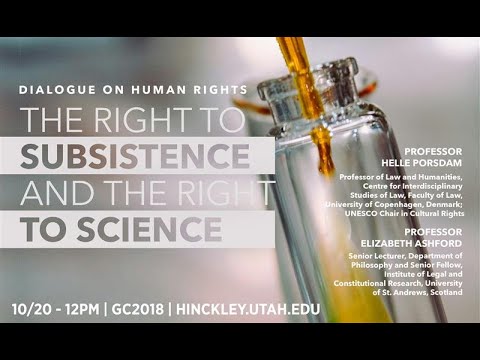
Professor Hela Porstam of the University of Copenhagen and Professor Elizabeth Ashford of the University of St. Andrews discussed the human right to science and related access issues at a Hinckley Institute forum at the University of Utah on Oct. 24, 2025. The event was moderated by Professor Dean Chatterjee and hosted by Rory Stewart of the Hinckley Institute of Politics.
Porstam noted that the right to science is explicitly referenced in major international instruments and described both the legal basis and practical access problems. “It is mentioned in the Universal [Declaration]… and also in the International Covenant on Economic, Social and Cultural Rights,” she said, adding that the covenant recognizes that “everybody has the right to benefit from scientific progress and its products.”
Porstam and Ashford said that treating scientific knowledge as a public good would strengthen democratic participation in science and attention to equity in global research access. “Much of it is behind paywalls, and you actually have to pay for it, to use it,” Porstam said, describing how paywalled journals and high barriers to scholarship limit researchers in parts of the global South.
Both speakers discussed intellectual property as a tension point. Porstam and Ashford said the historical purpose of intellectual-property rules is to provide incentives for creativity, but they argued those rules can be calibrated to better serve the public interest. Porstam said scholars and IP lawyers are exploring limitations and reforms that could make scientific knowledge more widely available while preserving incentives for innovation.
Panelists used the global coronavirus vaccine effort as an example of collaborative, non‑commercial scientific work. Ashford observed that many researchers “weren’t doing it to make money. They were doing it because they saw that the world needed their expertise,” citing the vaccine response as evidence that open, cooperative research can produce public benefits.
Speakers also raised risks from “dual use” research—scientific work that can be used for beneficial purposes and for harm—and discussed whether the right to science provides a public framework for oversight. Porstam urged that scientific freedom be balanced with responsibility: “We want to make sure that science happens… but we also need to make sure that it is checked in such a way that it doesn't end up as dual use science that can be misused.”
Audience questions ranged from whether wider access would reduce private innovation incentives to how to reconcile proprietary funding models with open access. Panelists said policy and law can offer tools—limitations on some forms of protection and mission‑sensitive funding models—to keep basic research available without eliminating incentives for applied innovation.
The panel also addressed language and epistemic inequities: Porstam described the dominance of English in academic publishing and the loss felt by scholars who can no longer publish in their native languages, and she urged greater respect for indigenous knowledge systems. The pair noted UNESCO’s ongoing work on the right to science; Porstam holds the UNESCO chair on that topic and said UNESCO supports framing science as a common global good.
In closing, Chatterjee and the speakers pointed to an upcoming Tanner‑Macmillan lecture at Westminster College that will revisit many of the forum’s themes in a longer public address the following evening.
Ending: The Hinckley Institute forum brought international scholars, faculty and students into a sustained discussion of whether existing legal norms and research‑funding models can be retooled to expand equitable access to scientific knowledge while managing risks from dual‑use technologies and AI.