
Residents and advocates urge council to expand rental assistance, find sites for Tent City 3 and 4
Get AI-powered insights, summaries, and transcripts
Subscribe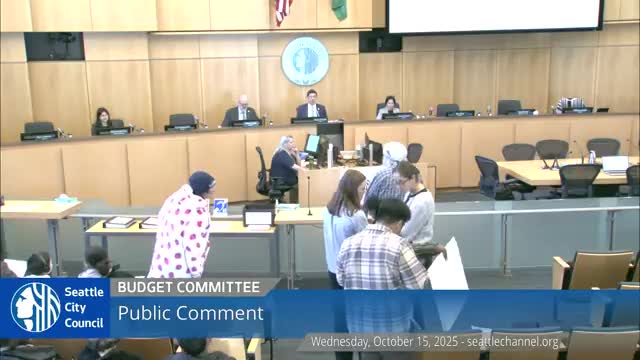
Summary
Dozens of public commenters — including staff from the Low Income Housing Institute and residents of Tent City 3 and Tent City 4 — pressed the Select Budget Committee to increase tenant-based rental assistance and identify relocation sites for encamped communities facing imminent move dates.
Dozens of residents and housing advocates told the Seattle City Council Select Budget Committee on Oct. 15 that immediate funding and site-finding are needed to prevent people in Tent City 3 and Tent City 4 from losing shelter.
Speakers at the hybrid public comment period included staff from the Low Income Housing Institute and multiple Tent City residents and organizers who described imminent moves and rising housing instability. "My belief that housing is a human right guides my work at the Low Income Housing Institute," said Kara Williams, a LIHI staff member, who urged the committee to adopt a total of $21,400,000 for tenant‑based rental assistance — an $11,400,000 baseline the mayor proposed plus an additional $10,000,000 to support nonprofit affordable housing portfolios.
The appeals came during the committee's public comment block, where people spoke in person then online. Council Chair Dan Strauss and staff explained the time limits and called the speakers in the order they registered.
Why it matters: Several speakers said the city faces both an urgent shelter crisis for encampment residents and rising operating costs for nonprofit housing providers. LIHI staff and residents argued that rental assistance prevents homelessness, supports vulnerable tenants (including seniors and people with disabilities) and reduces downstream costs for emergency shelter and crisis services.
What speakers told the committee - Kara Williams (Low Income Housing Institute, LIHI): urged the council to allocate $21,400,000 total to tenant‑based rental assistance, saying the proposed $11,400,000 "will help stabilize households before they fall into homelessness." - Molly Hardeman (Low Income Housing Institute): repeated the $11,000,000 ask in remarks and asked the council to add an additional $10,000,000 for nonprofit housing providers. - Martha Quirana (Community Engagement Manager, Low Income Housing Institute): thanked the mayor for tiny house funding and also asked the council to allocate $10,000,000 to LIHI's nonprofit housing portfolio in addition to the mayor's $11,000,000. - Tom Macaregg (Low Income Housing Institute): echoed colleagues and asked for the additional $10,000,000 to avoid displacements. - Jason (self‑identified member of Tent City 3): described the community's relocation crisis and said many people are "two paychecks away from being homeless." - Stacy Sorensen (Tent City 3): said both camps have imminent moves — "Tent City 3 has to move in 10 days. Tent City 4 has to move in just 4 weeks" — and warned that about 200 men, women and children could lose shelter. - Keegan (Tent City 3): described deep personal harm avoided because of Tent City 3, saying, "Tent City 3 saved me and my partner's lives." - December and Gabrielle Malone (youth speakers tied to shelter residents) described escaping domestic violence and the role of shelter and tent communities in keeping families together. - Lillian Phoenix (resident): spoke of fleeing abuse and homelessness and credited Tent City 3 with providing safety. - Alan Lapine (resident): cited more than 200 deaths of people who are unhoused so far this year and urged decisive action. - Anitra and other speakers urged the council to identify sites for Tent City 3 and 4 and to preserve community ties which commenters said are essential to survival. - Yvette Tinnish (commenter/advocate) suggested investigating heated, solar‑powered pod solutions and collaboration with Seattle Central College trades on construction.
Quantities and timing cited in public comment: several speakers gave specific figures or deadlines. Speakers described about 200 people facing relocation when camps lose sites; Tent City 3 was reported to have 10 days to move, and Tent City 4 four weeks in several remarks. LIHI staff repeatedly asked the committee to add $10,000,000 to the mayor's proposed rental assistance and to treat tenant‑based rental assistance as a prevention strategy.
Committee response and next steps: The public comment period concluded after in‑person and remote speakers. Committee members did not take a vote during the public comment block; the morning moved on to the agenda presentations covering the budget process and Central Staff analysis. Any funding decisions would arise later in the budget amendment and adoption process.
Ending: The committee adjourned public comment after hearing from the assembled residents and advocates and continued with the staff presentations on the mayor's proposed 2026 adjustments and general fund analysis.