
Council asks BFRW to clarify how RCW 19.27.600 affects fire-area and occupant-load calculations for child care centers
Get AI-powered insights, summaries, and transcripts
Subscribe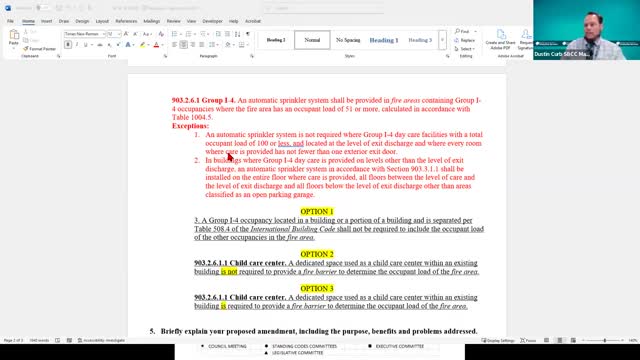
Summary
Following confusion among jurisdictions, the Building Code Council directed its Building Fire & Residential/Accessibility (BFRW) committee to draft options clarifying how RCW 19.27.600 should interact with building-code fire‑area and occupant-load calculations for child-care centers in existing buildings.
The council directed the Building Fire & Residential/Accessibility committee on Oct. 17 to develop recommendations clarifying how RCW 19.27.600 applies to child-care centers in existing buildings and how the statute should be interpreted alongside building-code fire-area and occupant-load rules.
Proponent Ken (last name in transcript: Burlette was introduced earlier as representing the City of Seattle Fire Department) told the council that local plan reviewers are finding inconsistent interpretations. The statute was intended, proponents said, to allow child-care uses in existing spaces without automatically triggering full-building occupant-load calculations that can require sprinklers or structural separation — but the wording left ambiguity about whether a fire barrier is required to separate the activity area from the rest of the building for the purpose of computing the fire area.
Ken presented three draft options for the council to consider: (1) permit the existing exception so that, when a childcare area within a larger fire area is separated by a fire barrier (per Table 508.4) the occupant load for the childcare area is calculated independently; (2) interpret the statute so a fire barrier is not required to calculate the childcare occupant load (allowing the childcare area to be treated separately without physical separation); or (3) require that a fire barrier be installed to create a separate fire area for the childcare use (forcing separation to avoid combining occupant loads). Ken said that jurisdictions such as Seattle were already encountering conflicting local determinations.
The council voted to send the matter to the BFRW committee for further analysis and to return recommendations at the next full council meeting. Council members and staff discussed possible pathways including expedited rulemaking, emergency rulemaking, or incorporation in the next code cycle depending on the degree of policy discretion and whether the changes are mechanical alignments to statute.
Why it matters: Depending on the approach, the rule could materially affect when sprinkler systems or other life-safety upgrades are required for existing buildings that add child-care operations, with implications for operators, building owners, and permitting authorities.
Next steps: BFRW will analyze the options, consult stakeholders (fire marshals, jurisdictions, architects and child-care operators), and recommend a regulatory pathway and draft language for council consideration.