Get Full Government Meeting Transcripts, Videos, & Alerts Forever!
Get email alerts on the Criminal Procedure Certified Question topic
No spam. Unsubscribe anytime.
Tennessee high court weighs effect of State v. Green on Rule 37 certified questions
Summary
At oral argument in State of Tennessee v. Torian Chantal Bishop, defense and the Attorney General disputed whether a certified question limited “exclusively” to the smell of marijuana remains dispositive after this court’s decision in State v. Green and whether the Rule 37 procedure needs procedural reform.
The Tennessee Supreme Court heard argument Oct. 25 in State of Tennessee v. Torian Chantal Bishop over whether an agreed certified question that asks whether probable cause existed “based exclusively on the allegedly plain smell of marijuana” remains dispositive in light of this court’s decision in State v. Green, and whether changes to Tennessee Rule of Criminal Procedure 37 are warranted.
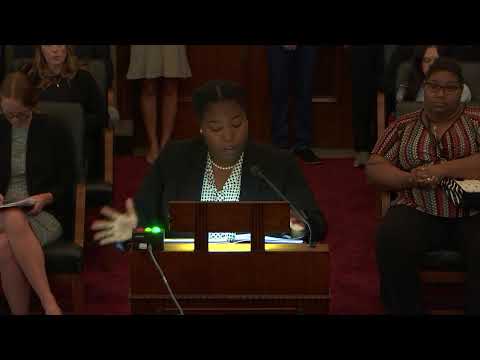
Appellate Division attorney Jessica Butler, arguing for Bishop, told the court, “We are asking the court to answer 2 questions today,” and urged the justices to hold that the certified question remains dispositive because the trial court’s factual finding was that the officer relied only on the odor. Butler argued that Green reaffirmed a totality-of-the-circumstances test but did not change the law, and that here “the totality of the relevant circumstances is the smell.” She asked the court either to treat the question as dispositive and remand for reconsideration by the Court of Criminal Appeals or, if the court adopts procedural changes, to adopt them in Bishop’s favor, including permitting withdrawal of a guilty plea when a certified-question appeal is dismissed.
Counsel for the state, Matt Cloutier of the Attorney General’s Office, said that Rule 37 certified questions have long been an exception to the general rule that there is no right to appeal from a guilty plea and that the rule requires the certified question be dispositive. “Since they were first permitted nearly 50 years ago, Rule 37 certified questions have been an exception to the general rule that there's no right to appeal from a guilty plea,” Cloutier told the justices. He argued the certified-question procedure is meant to produce efficient, final resolution and that questions that are not truly dispositive should be dismissed for lack of jurisdiction. Cloutier recommended clarifying the rule through rulemaking rather than by judicial revision.
Both advocates pressed several procedural fixes during argument. Butler proposed requiring more explicit on-the-record trial-court findings or a more robust plea colloquy to make clear why parties believed a question was dispositive, and she said the practice of the state agreeing to a dispositive question at the trial level and then withdrawing that endorsement on appeal leaves defendants disadvantaged. Cloutier said the better approach is to preserve a strict dispositive requirement, limit Rule 37 to questions that are truly case-ending, and, if broader change is desired, pursue formal rulemaking.
The justices probed the role of the Attorney General when it reviews appeals that the local district attorney initially certified as dispositive. Several justices emphasized the tension between the trial prosecutor’s pragmatic assessment of evidence and the Attorney General’s appellate review from the “cold record.” One justice asked whether it would be appropriate to require the prosecutor to state on the record at the plea colloquy that the case would not proceed if the question were resolved one way or the other; Butler said that was essentially what the state’s agreement already implies and that making it explicit would not change the dynamics. Cloutier responded that a clear on-the-record statement could help but that more sweeping changes should go through the rulemaking process.
The underlying facts are procedural and have been litigated multiple times. The dispute began with a motion to suppress evidence obtained after a warrantless search of Bishop’s vehicle. The trial court initially granted suppression based on an officer’s testimony that the search was prompted by the odor of marijuana, later reconsidered and denied suppression, and Bishop entered a plea reserving the certified question. The Court of Criminal Appeals initially found the certified question complied with Rule 37 but, after this court’s decision in State v. Green, later determined the question no longer complied and dismissed the appeal. Butler argued Green did not remove dispositive status; the Attorney General argued the case requires dismissal because the question cannot be dispositive under controlling precedent.
No decision was announced at argument. The court recessed after closing remarks and will issue a written opinion later that will resolve (a) whether this specific certified question is dispositive in light of Green and (b) whether—and by what mechanism—the court should clarify or change the administration of Rule 37 certified questions.