
San Angelo discusses new approach to assist developers with oversized infrastructure
Get AI-powered insights, summaries, and transcripts
Subscribe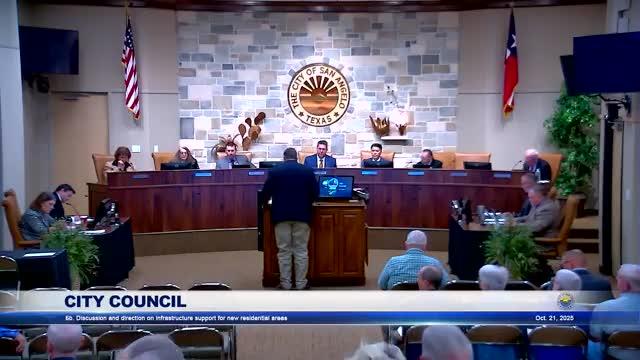
Summary
Council held a broad discussion on city assistance for costly oversized utilities and arterial road work, with staff and developers exploring developer agreements or phased reimbursement to accelerate higher‑density housing.
San Angelo city staff and developers discussed potential city assistance on Oct. 21 for costly oversized infrastructure — such as larger water and sewer mains and widened arterial streets — that is slowing new residential development on the city’s outskirts.
Public Works Executive Director Shane Kelton told the council that developers often must install larger pipes, stronger bedding and wider streets now to accommodate future growth, and those up‑front costs can make projects financially unfeasible. He said the city has been approached by multiple developers seeking help to cover those incremental costs so subdivisions can proceed at higher densities rather than defaulting to half‑acre lots with septic systems.
Kelton outlined one concept staff has discussed with the city attorney and developers: the city would fund the oversized portion of infrastructure up front and be reimbursed over time as lots within the development are sold. He described several possible contractual instruments — voluntary assessment, developer’s agreement or other repayment mechanisms — and said staff would return with a detailed policy if council approves the general approach.
Developers and consultants in the audience said they welcome a public‑private approach. Russell Gulley of SKG Engineering said successful models exist in other Texas cities and noted that historically the developer bore fittings, bedding and trench costs that scale nonlinearly with pipe size. Builder Derek (Eric) Von Rosenberg described a recent project where escalating infrastructure costs forced a pivot from higher‑density lots to half‑acre tracts, and said the city’s involvement could restore affordable lot economics.
Council members expressed broad support for continuing the conversation. Mayor Tom Thompson told staff the discussion prompted “a lot of hope and a lot of optimism” and urged the city to pursue options that increase housing supply, noting new homes expand the tax base. Multiple council members said they prefer city‑developer partnerships to building more septic‑served lots inside the city limits.
Kelton and developers said next steps would be for staff to draft sample contract language and a policy framework, quantify costs for specific projects and return to council for policy approval. No formal action was taken at the meeting; council directed staff to continue discussions with the development community and prepare a policy proposal for a future agenda.