Get Full Government Meeting Transcripts, Videos, & Alerts Forever!
Get email alerts on the Compensation And Benefits Study topic
No spam. Unsubscribe anytime.
Brazos County reviews Segal compensation and benefits study; staff questionnaires to begin
Summary
At a special workshop, Brazos County Commissioners Court and HR heard consultants from Segal outline a job-based classification and market-pay study. The firm and county staff emphasized extensive employee questionnaires and a timeline that targets final results in first quarter 2026.
Brazos County Commissioners Court met at 9 a.m. for a special workshop to receive a presentation from Segal, the county's consultant on a compensation and benefits study intended to replace the county's group-and-step pay system.
Jennifer Salazar, a human resources representative for Brazos County, told the court, "this workshop marks an important milestone in Brazos County's compensation and benefits study," and thanked department heads and IT staff for providing payroll and job data pulled from Oracle.
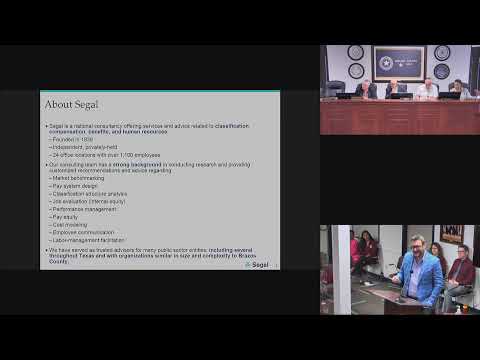
The study aims to create clear job classifications, build a market-based pay structure that uses data from comparable counties and organizations, evaluate benefits, and provide an implementation framework that includes a performance-management component. Segal consultants said the work will separate job-based analysis (to build the classification system) from incumbent-based variables (to move employees into new pay ranges once the system is set).
A Segal presenter (identified in the workshop as Tiel) said the county will choose the peer organizations used for market comparisons: "What we do is a custom analysis. So your organization will specify the entities to which we compare your salaries to." The firm explained it will apply geographic differentials where appropriate and use reputable indices to normalize cost-of-labor differences.
Segal staff described the process: an extensive job-description questionnaire for employees, supervisor review (with supervisory feedback visible to Segal and HR but supervisors not permitted to alter employee submissions), focused interviews or follow-ups as needed, and simultaneous internal classification and external market analysis. The consultants said questionnaires will be demonstrated to staff and are expected to be completed in about a one-month window.
On timing, Segal told the court it expects to have the internal data assembled for county analysis by December and to deliver final study results in the first quarter of 2026. The consultant also noted external market data sources update frequently, saying the Economic Research Institute data is refreshed roughly every six weeks.
Commissioners pressed for clarity on which organizations would be used in comparisons and on how the study will account for local hiring pressures. Commissioner Brown asked whether comparisons could include high-cost regions; Segal replied that the choice of peer agencies is the county's and that geographic indices will be used to make cost-of-labor comparisons meaningful. Commissioner Watson and Commissioner Collins also discussed hiring pressures in the Bryan–College Station labor market and how some job families (for example, IT and finance) move faster in the market than others.
No formal action or votes were taken during the workshop. County officials emphasized the need for broad staff participation: more than 20 department heads and elected officials were in the audience and Segal and HR plan meetings with departments and elected officials this week to support questionnaire completion.
Next steps: HR and Segal will distribute the job-description questionnaires to employees, conduct one-on-one and department meetings scheduled this week, collect peer-agency data as defined by the county, and work toward transferring full study documentation to the county after recommendations are finalized in early 2026.