Get Full Government Meeting Transcripts, Videos, & Alerts Forever!
Get email alerts on the Wildfire Prevention topic
No spam. Unsubscribe anytime.
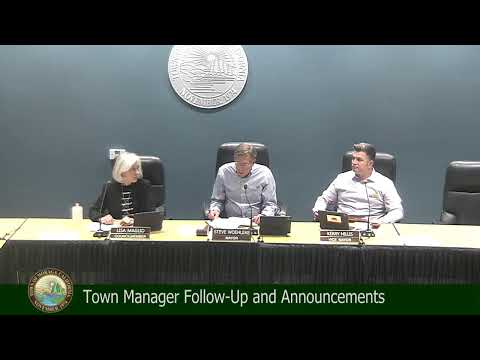
Moraga council hears update on Firewise network, grant challenges and Measure X spending
Summary
At its Oct. 15 meeting, the Moraga Town Council received a presentation from the Moraga‑Orinda Firewise Network on neighborhood defensible‑space programs, grant efforts and a planned wildfire newsletter; staff also noted recent Measure X funds and an upcoming county evacuation study RFP.
Moraga Town Council members on Oct. 15 received an update on local wildfire‑prevention work from the Moraga‑Orinda Firewise Network and heard town staff describe recent Measure X funding for public property abatement and a countywide evacuation study request for proposals.
Mark Evans, chair of the Moraga‑Orinda Firewise Network, told the council the network now recognizes about 43 Firewise neighborhoods across the fire district and is organizing homeowners around defensible‑space work, cost‑share grants and outreach. "I am Mark Evans. I am currently the chairperson for the Moraga‑Orinda Firewise Network," he said, summarizing the group's role in coordinating resident education and neighborhood projects.
The Firewise group is focusing on defensible space and neighborhood cost‑share projects, Evans said. The network's model uses multi‑household contracting to reduce per‑property costs; Evans said the neighborhood approach can yield roughly 30% savings compared with individual contracts. The program typically uses 50/50 matching funds and, in the group's current practice, caps matching grants at $10,000 per property.
Evans described operational work the network has completed and its grant program efforts. He said the group's nonprofit, Fire Safe Moraga‑Orinda (a 501(c)(3) public benefit corporation formed in 2023), has submitted multiple grant applications but faces headwinds in competitive federal programs because affluent communities receive lower points under certain USDA and other grant scoring criteria. "We scored 84," Evans said of a recent federal application; he added that selected projects in California scored in the low 90s.
Evans also said the network is planning a quarterly wildfire‑prevention newsletter, to begin in January, and is seeking a town staff contact to coordinate content and distribution. He requested that the town identify a designee to work with the network and the Moraga‑Orinda Fire District on the publication.
Town staff reported related, town‑level activity. Town Manager Scott said the county budgets Measure X revenue for fire abatement and noted Moraga's recent share: of the countywide $2.2 million allocation for fire abatement in 2024, Moraga received about $675,000 (roughly 31% of that allocation); staff also reported the town obtained an additional $50,000 from other sources. Scott said the town spent nearly three‑quarters of a million dollars last year on vegetation abatement on town‑owned property and on trails.
Scott also flagged a countywide evacuation study RFP being advanced by the Contra Costa Transportation Authority that Moraga officials hope will move forward. "That should be... out on the street hopefully," he said, noting the study could take several months and possibly up to a year once a contractor is selected.
Evans described how the network identifies vulnerable residents who cannot manage defensible‑space work on their own and targets assistance to those households through group projects and matching funds. He gave an example of a large property that received $60,000 of fuel‑reduction work after neighbors and volunteers helped coordinate contractors and bids.
Several councilmembers and staff noted operational issues the network has faced when administering grant‑funded work, including delays in federal reimbursements and the need to tighten contractor selection and bidding processes. Evans said the network will require competitive bids and proof of insurance and licensing for contractors in future rounds.
No formal council action was taken on the presentation. The meeting record shows routine procedural votes — adoption of the meeting agenda and the consent agenda — were approved by voice vote without roll‑call tallies recorded in the transcript. The council adjourned to a closed session after the public portion of the meeting.
Next steps described at the meeting include the network's plan to begin a coordinated wildfire newsletter in January, continued grant writing and neighborhood defensible‑space projects in early 2026, and anticipated participation in the county evacuation study should the Contra Costa Transportation Authority issue the RFP as expected.