Get Full Government Meeting Transcripts, Videos, & Alerts Forever!
Get email alerts on the Facilities Maintenance topic
No spam. Unsubscribe anytime.
District officials outline facilities backlog; board authorizes maintenance grant application and emergency HLS spending
Summary
Ball Chatham CUSD 5 facilities director detailed aging equipment and major projects while the board authorized a $50,000 matching maintenance-grant application, approved health-life-safety (HLS) emergency spending to repair a collapsed sewer under the middle-school parking lot, and approved disposal of two retired school buses.
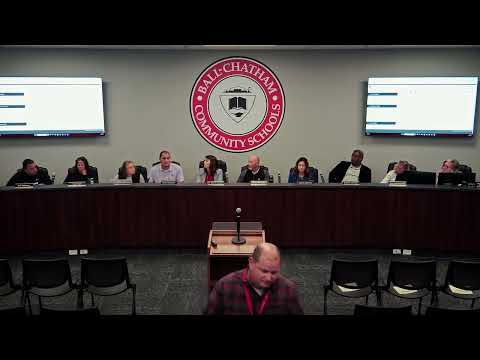
Jared Kester, director of facilities for Ball Chatham CUSD 5, told the Board of Education on Oct. 22 that the district’s maintenance and operations budget is stretched and that buildings and equipment are aging, and then asked the board to authorize pursuing a state maintenance grant and ratify emergency HLS spending for an already-repaired sewer collapse.
Kester said the district is seeking a matching maintenance grant that would reimburse $50,000 on a $100,000 project and asked the board for a resolution authorizing submission. “So what we're looking for tonight is, just a resolution,” Kester said. He described likely projects as replacement domestic water heaters, valves and other smaller-but-urgent infrastructure fixes and said the district would return later with a detailed cost breakdown.
The board approved the grant application. The motion to authorize staff to submit the $50,000 maintenance grant request was moved by Board Member Coburn and seconded by Board Member Polletta; the motion passed with an affirmative vote recorded.
Kester also presented a facilities overview that listed how the maintenance-and-operations budget is allocated and described staffing and workload pressures. He said about 51% of that budget supports salaries and benefits for 49 employees, 29% covers supplies (cleaning and custodial materials), 11% covers purchased services (utilities) and 9% covers other miscellaneous expenses. “Our mission is to provide a safe, clean, and comfortable environment that is conducive to teaching and learning,” Kester said, and he described a work-order system (eSpace) and plans to build a preventive-maintenance program after cataloging district assets.
Kester gave project cost summaries for recent and planned work: the transportation building at about $540,000; Chapman Elementary HVAC at $3.5 million (including geothermal wells); Chatham Elementary parking at just over $1 million; middle school parking improvements at about $1.6 million; high-school dugouts at about $650,000; and a high-school auditorium audio upgrade at about $485,000. He said initial estimates for the Ball Elementary HVAC project are roughly $4.2 million and the roof at about $1.6 million but cautioned bids will determine final costs.
The board also ratified an emergency HLS resolution after the district repaired a collapsed sanitary sewer line under the middle-school parking lot that had caused backups to the concession stand and raised concerns about adjacent facilities. Kester told the board that the repair work had already been completed because it was an emergency and that state rules require the board to authorize HLS expenditures at the next meeting. The motion to authorize use of HLS emergency funds for the sewer repair was moved and seconded; the board recorded an affirmative vote and approved the measure.
Separately, the board approved disposal of two retired buses the district plans to use in emergency management training and then scrap. The facilities staff said salvageable parts had been removed but that many parts were incompatible with newer bus engines. A motion to dispose of the two buses passed.
Board members asked about staffing, preventive maintenance and the use of the work-order system to capture asset details, invoices and lifecycle information that would inform future replacement decisions. Kester said the district handled about 1,853 work orders in the past year (roughly 200 per month) and that custodial and grounds staff currently operate at levels above recommended industry standards for reactive work.
The board did not change any budgets at the meeting; it authorized the grant application, ratified emergency HLS spending and approved bus disposals, and it directed staff to return with specific project cost breakdowns and follow-up details for implementation and bidding.
Looking ahead, Kester and members discussed using the county 1% sales-tax capital funds and prioritizing health and life safety, mechanical replacements and infrastructure work as projects move into budgeting and construction phases.