Get Full Government Meeting Transcripts, Videos, & Alerts Forever!
Get email alerts on the Special Education Behavior Interventions topic
No spam. Unsubscribe anytime.
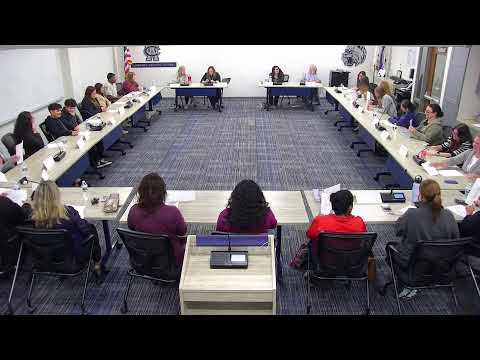
CHSD 94 PTAC reviews draft behavior-intervention policy aligned with ISBE guidance
Summary
Parents, staff and district specialists reviewed a legal‑counsel‑drafted policy on behavior interventions for students with disabilities; the committee asked for a redlined version and staff said families would receive updated policies within 15 days of adoption.
The Parent Teacher Advisory Committee for Community High School District 94 reviewed a draft behavior‑intervention policy on Oct. 15 that district staff said was updated to align with Illinois State Board of Education (ISBE) guidance and state school code.
Megan Peilatner, director of specialized services, told the committee the draft combined prior documents and emphasized "least restrictive environment," functional behavior assessment and behavioral intervention plans. "The more intrusive an intervention is, the more caution, oversight and documentation must accompany it," Peilatner said.
Peilatner said the guidance the district followed is non‑regulatory advice from ISBE and that the school code and federal law determine legal requirements. She said families must receive the policies once a year and that, if the draft is adopted, "all families will receive a new copy as well within 15 days of it being adopted." She also said staff would add any required behavioral interventions to students' individualized education programs (IEPs) and obtain consent for functional behavior assessments and behavioral intervention plans.
Committee members asked for a redline version showing changes from the prior policy. A parent requested a redlined copy to review; Peilatner said the current policy was posted on the district website and staff would provide the redlined and combined documents electronically. "What happened was it was two separate documents that we have. ... Based on the updates, we've now combined it into the one document and updated it with more positive behavioral supports," Peilatner said.
Peilatner described training and oversight: district staff receive de‑escalation and positive behavior supports; only staff with CPI (Crisis Prevention Intervention) certification are permitted to use approved physical interventions, and the district has not used hands‑on restraint at the high school in recent years. She said the district maintains documentation for any restrictive interventions and reports to ISBE when they occur.
Parents and staff asked about scope and monitoring. Peilatner said teams perform functional behavior assessments when behaviors increase and that behavioral intervention plans define supports and crisis responses. She described an oversight committee to ensure consistent practices and staff training; she said behavior‑analysis consultants could be used as needed.
The draft labels interventions on a continuum from non‑restrictive (verbal redirection, prompting) to restrictive, highly restrictive and prohibited. Peilatner said more intrusive strategies "should only be used when absolutely necessary for the shortest duration needed," and that ISBE monitors districts for overuse of restrictive practices.
Committee next steps included collecting feedback and forwarding the draft for possible Board of Education consideration. Peilatner and other staff agreed to provide committee members an electronic redlined comparison and to ensure families of students initially qualifying for special education receive the required notices.