Get Full Government Meeting Transcripts, Videos, & Alerts Forever!
Get email alerts on the Piney River Water Sewer Rates topic
No spam. Unsubscribe anytime.
Nelson County pauses vote after residents urge rework of Piney River water-rate plan
Summary
After a public hearing with numerous Piney River residents objecting to large, phased increases in water and sewer charges, the Nelson County Board of Supervisors agreed to take no action and continue the matter for further discussion, including budget review and potential income-based relief options.
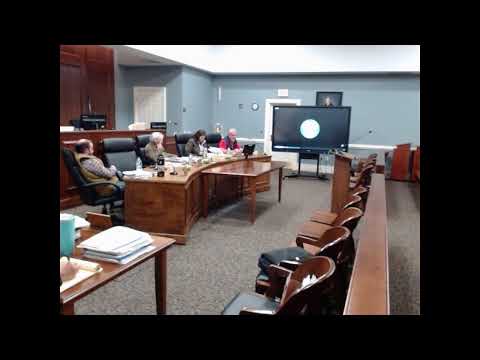
The Nelson County Board of Supervisors on an evening session paused action on an ordinance that would raise Piney River water and sewer rates after dozens of residents urged the board to reconsider the size and pace of the increases.
Candy McGarry, county utilities staff, opened the public hearing and described proposed ordinance O-2025-09, an amendment to Nelson County Code Chapter 12 (Utilities), Article 3 (Water and Wastewater), Division 10. McGarry said the increases would begin Jan. 1, 2026, with additional annual adjustments on July 1 through 2028, and that letters had been mailed to 207 Piney River customers as required by the board’s resolution R-2025-68. She said the county has not adjusted these rates since 2013 and that rising maintenance and capital costs have required supplemental funding from the general fund.
Residents who spoke at the hearing described the increases as unaffordable for people on fixed or low incomes. “I’m single, one income, taking care of one person,” Stephanie Evans said. “I can’t keep up with a 25% increase for January, and then another jump in July.” Sean Pannell, a Piney River resident, raised specific concerns about large hikes to hydrant/yard-connection fees and grinder-pump charges, calling some proposed changes “excessive.” Esther Page, representing Saint James Baptist Church, urged the board to consider relief for small congregations and noted the church’s historical role in the community’s early water efforts.
McGarry outlined the principal elements of the proposal: connection fees shown by meter size would roughly double effective Jan. 1, 2026; the monthly water minimum (for a 4,000-gallon baseline) would rise from $29.90 to $34.36 on Jan. 1, 2026, then to $38.82 on July 1, 2026, $43.28 on July 1, 2027, and $52.20 on July 1, 2028. Per-1,000-gallon overage charges, sewer base fees, grinder-pump fees (currently $9 per month), and other charges were also scheduled to increase in the same phased schedule. McGarry said some fees would be added or raised to better align the county code with the Nelson County Service Authority’s ordinance, including a return check fee from $25 to $50, a copy fee from $2.50 to $10, new customer-requested service and opinion fees ($25 and $50 respectively), and a minimum misuse/damage fee of $500. Unauthorized-use charges would remain at $500 initially with a proposed higher daily charge up to $1,000.
Speakers repeatedly asked how the county would protect elderly and fixed-income residents. “Many of our elderly neighbors are already choosing between keeping the heat on,” Roberta Brown told supervisors, urging consideration of income-based billing or external grant funding. Georgia Brownhill, who said she lives on Social Security, asked what would happen to customers unable to pay septic or sewer bills. Several speakers contrasted the Piney River proposal with other local jurisdictions’ rates and questioned the reason for a 4,000-gallon monthly baseline.
Commissioner Reid (a member of the Nelson County Board of Supervisors) acknowledged the history: the board and its predecessors have postponed systematic increases since the last rate change in February 2013 and said the county needs a sustainable, predictable approach. Reid said the Piney River system differs from others in the county because it was built to correct public-health problems—“land in Piney River doesn’t perk,” Reid said—so he recommended reevaluating ownership transfer to the Nelson County Service Authority and exploring income-based relief. After board discussion the supervisors agreed to take no action on O-2025-09 at the meeting and move further consideration into upcoming budget discussions.
The board then voted to adjourn and continue the meeting on Oct. 22. A roll-call was taken; members voting in favor included the board members recorded as Caroline, Mr. Carr, Mr. Rutherford and Mr. Reese.
The county staff presentation and public record contain detailed line items and timetable proposals; the board left those numbers on the table for staff to review further with the community and to return with alternatives or clarifications in future budget meetings.
What happens next: because the board took no action, the ordinance O-2025-09 was not adopted. Staff indicated the first scheduled increase—Jan. 1, 2026—remains in the proposal, but supervisors asked for additional outreach, consideration of an income-based assistance program, and further evaluation before any ordinance is adopted.