Get Full Government Meeting Transcripts, Videos, & Alerts Forever!
Get email alerts on the Land Use Nonconforming topic
No spam. Unsubscribe anytime.
Mesa council reviews proposed code amendments to clarify legal nonconforming and ‘procedurally conforming’ sites
Summary
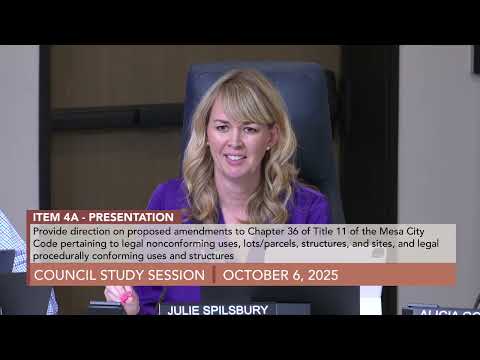
Mesa City Council members on Oct. 6 reviewed proposed amendments to the city code intended to clarify how the city treats legal nonconforming lots, structures and sites and to create a new category called "procedurally conforming" uses.
Mesa City Council members on Oct. 6 reviewed proposed amendments to the city code intended to clarify how the city treats legal nonconforming lots, structures and sites and to create a new category called "procedurally conforming" uses.
Planning Director Mary Kopaski Brown told the council the amendments would replace the current Chapter 36 with language that separates legal nonconforming lots, structures and sites and adds definitions and procedures to make administration clearer. "We're looking to restructure it so that it's easier for us as staff to administer it," she said.
The proposed changes would, among other items, increase the trigger at which a damaged nonconforming structure must be brought into full compliance. Under current code, staff said, the threshold is 50 percent of the cost to rebuild; the draft amendment would raise that threshold to 75 percent. Evan, a planning staff member who spoke during the session, explained the practical test: if the cost to repair a nonconforming building exceeds the stated percentage of the cost to reconstruct it, the owner would be required to bring the structure into conformance.
Nana Appiah, development services director, said the rewrite also adds rules for legal nonconforming sites that the current code does not address and creates a permitting path — a substantial conformance/improvement permit heard by the Board of Adjustment — so modifications move through a formal process. "These go through the board of adjustments so that we're making sure that these nonconformities are going through a process," Appiah said.
Staff also proposed a separate category for legal procedurally conforming uses and structures. Kopaski Brown said that category is intended for projects that received zoning entitlements and building permits but were later determined by a zoning administrator to fall outside any land-use classification; in that situation, the use could be designated procedurally conforming and treated differently than traditional nonconforming uses. "This use can be completely rebuilt if destroyed, which is different than the nonconforming uses," Kopaski Brown said, adding that the designation would allow the city to preserve the legal status of projects built under prior approvals while preventing expansion beyond the original scope.
Kopaski Brown cited a local example: the battery energy storage project on Signal Butte Road was interpreted under current code to be a nonconformity after it had received site-plan approval and a permit. That determination, she said, created financing concerns for the developer because of limits on rebuilding. The draft ordinance would allow that first project to be considered a legal procedurally conforming use so it could be rebuilt if destroyed, but would bar expansion beyond the previously approved scope.
Councilmembers asked procedural and policy questions. Councilmember Spilsbury sought clarification whether the percentage test referred to area destroyed or to cost to rebuild; staff confirmed it is the cost to rebuild. Councilmember Adams asked what informed the choice of 75 percent; Kopaski Brown said it reflected staff professional judgment to provide more flexibility for existing businesses and was not tied to a specific external formula. "The 75% is just your best professional judgment as opposed to 80 or 65 or whatever," Adams said when summarizing the exchange.
Kopaski Brown told the council a modified version of the ordinance on the agenda did not include the language for the second part of the proposal (the broader procedural-conforming section), and that the council would have future opportunities to consider or add such language by ordinance.
The discussion was informational; no ordinance vote was taken at the study session. Staff said they will return with refined draft language and that related applications for permits would continue to be administered under existing processes until the council takes formal action.
Next steps: staff will bring revised ordinance language back to the council for further consideration and formal action at a later meeting.