Get Full Government Meeting Transcripts, Videos, & Alerts Forever!
Get email alerts on the Workforce Development topic
No spam. Unsubscribe anytime.
Central Minnesota Jobs and Training Services briefs McLeod County on programs and funding pressures
Summary
Central Minnesota Jobs and Training Services told the McLeod County Board it serves 11 counties including McLeod, offers job-seeker and employer services, and is addressing cuts to state dislocated-worker funding while pursuing other grants and private support.
Dina Awareness, executive director of Central Minnesota Jobs and Training Services (CMJTS), told the McLeod County Board of Commissioners that CMJTS provides job-seeker and employer services across 11 counties, including McLeod, and that state and federal funding uncertainty is driving a push for more diversified revenue.
CMJTS “serves McLeod County,” Awareness said, noting the agency covers counties north to Pine and south to Renville. She told the board that, as of a Sept. 3 program-year report included in the board packet, CMJTS had served 209 individuals in the current program year and that the agency administers the McLeod County MFIP employment-services contract.
The presentation outlined CMJTS services for job seekers — from career assessments and résumé help to certification support and job-placement assistance — and business services, including incumbent-worker training, apprenticeship support and help organizing job fairs. Bridget Paulson was identified in the presentation as the CMJTS business service coordinator for McLeod County and the primary local contact for employers.
Awareness described CMJTS’s funding mix as “federal grants, state grants, local grants, foundation and donor funding,” and said the agency is seeking private contributions as state and federal streams become less reliable. “Our state dislocated-worker funds were cut 56% this year,” she said, adding that the Job Skills Partnership Board agreed to release reserve funds to hold regional providers harmless for the current year. Awareness also said CMJTS is watching Workforce Innovation and Opportunity Act (WIOA) federal dollars closely.
Board members asked for program and performance numbers and for clarification about local referral paths. Awareness said dislocated workers are typically routed to job services when they apply for unemployment; the state Department of Employment and Economic Development (DEED) job-service team performs an initial assessment and refers eligible individuals to the regional dislocated-worker provider such as CMJTS. She also said CMJTS tries to engage businesses in advance of a planned closing so services can begin while workers are still employed.
Commissioners asked whether CMJTS works with small employers; Awareness said the program is small-business focused and that the workforce development board’s membership is intended to ensure small-business representation. The presentation described an incumbent-worker training fund that can contribute up to $25,000 per business once per 12-month rolling period to support upskilling and avoid layoffs.
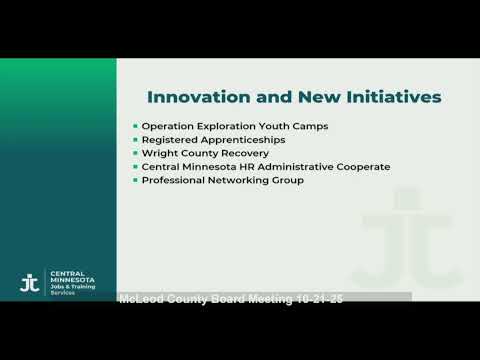
Awareness also summarized CMJTS strategic planning work, saying the agency is investing in “storytelling” and outreach to increase public and employer awareness of CMJTS services. She said CMJTS has received several recent grants and has multiple grant applications pending.
Commissioners asked about regional unemployment data; Awareness said CMJTS has a DEED labor-market analyst who presents monthly figures and that the region’s unemployment rate is roughly consistent with Minnesota’s overall rate (about 3.5 percent), while some northern counties have higher rates.
The board did not take formal action on the presentation. Commissioners thanked Awareness and noted interest in receiving the program-year service counts and any follow-up materials referenced in the packet.