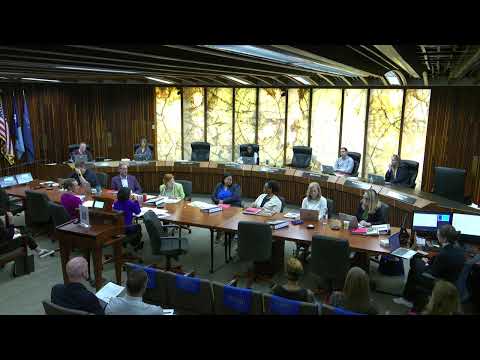
Hennepin County holds statutory fee hearing; commissioners press solid-waste, library and human-services questions
Get AI-powered insights, summaries, and transcripts
SubscribeSummary
Hennepin County administration opened the annual statutory fee hearing on proposed 2026 departmental fee changes and new fees, prompting commissioner questions about solid-waste funding, hauler penalties, HERC maintenance funding and resident-facing human-services technology.
Hennepin County administration presented proposed 2026 revisions to departmental fee schedules and opened the required fee hearing on Oct. 20, describing nine departments' proposed changes and seven new fees.
Jody Wendland, county administrator, told the committee departments considered fee purpose, payer and cost of service and noted many fees have not changed for five years or more. Lindsay Walsh Lager, operating budget coordinator, and department representatives were available to answer questions. The records distributed with the packet included proposed line-item changes across county departments.
Commissioners concentrated questions and comments on solid-waste revenue and enforcement, Hennepin County's recycling and energy facility (HERC) maintenance funding, penalties for excess cardboard brought by haulers, and whether the county could better coordinate tire drop-off and recycling with the Mosquito Control District. Key points raised during the hearing:
- Ordinance 18 and Ordinance 15: Dave McNary explained that Ordinance 18, established in 1995 to fund a large Elk River recovery project, has been zeroed out since 2009 after that project concluded. Current solid-waste revenues come primarily from tipping fees and Ordinance 15 (a fee placed on residential and commercial garbage bills), which McNary said generates approximately $35,000,000 at its peak. Commissioner Angela Conolly suggested the board consider revisiting Ordinance 18 to support current 0-waste goals.
- Penalties and enforcement: Commissioner Conolly and others urged stronger penalties for haulers who deliver excess cardboard or inappropriate material to the HERC or county transfer stations. The packet lists an "excess cardboard and trash penalty for haulers" with a proposed $50 increase; several commissioners suggested a larger increase or a phased increase as a stronger deterrent.
- HERC facility maintenance funding: The Environmental & Energy recurring HERC facility maintenance line in the CIP is budgeted at roughly $6,000,000 annually (enterprise-funded). Staff said this recurring project is used to fund a multi-year work plan; unspent authority rolls forward until the project is closed and remaining funds revert to the enterprise fund. Commissioners asked for historical accounting of prior CIP balances and how much was spent versus returned.
- Tire disposal and public-health alignment: Commissioner Kevin Anderson asked whether the county could coordinate with the Mosquito Control District on tire collection and reuse; Dave McNary said the county sells collected tires to recyclers and agreed to follow up with the Mosquito Control District about possible synergies.
- Resident-facing technology and human services: Commissioner Carolyn Edelson pressed for capital investments that improve the resident experience for human services (for example, easier online access and lower rejection rates for benefits). County staff noted many client-facing improvements were funded in earlier capital cycles and that larger technology modernization efforts may involve state-managed systems and require separate funding partnerships.
No members of the public testified in person during the hearing; the clerk reminded residents that recorded comments could be left by phone and would be played at later budget hearings. With no substantive public testimony, the committee approved a motion to lay over remaining budget items until Wednesday, Oct. 22, when the hearings will continue.
The discussion included follow-up requests from commissioners for more data: a breakdown of HERC spending versus returned enterprise balances, consideration of stronger hauler penalties for contaminants, and staff follow-up on possible partnerships for tire disposal and on the impacts of fees on low-income residents.