Get Full Government Meeting Transcripts, Videos, & Alerts Forever!
Get email alerts on the Public Works Budget topic
No spam. Unsubscribe anytime.
City Manager outlines public works-related department budgets including airport, street operations and equipment purchases
Summary
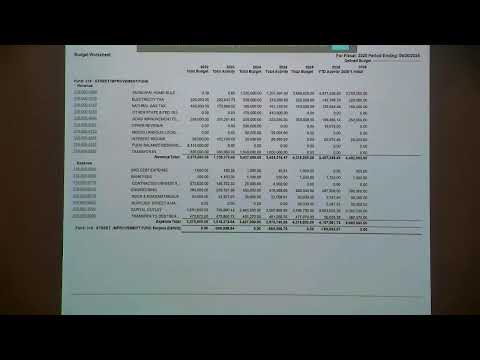
City Manager Boyer reviewed multiple public-works budgets for 2026, including airport contract and fuel system work, street operations staffing and equipment, cemetery, forestry, animal control, traffic engineering, street lights and the capital equipment fund.
City Manager Boyer presented the proposed 2026 budgets for public-works functions at a Freeport City Council meeting, covering airport management, street operations, equipment purchases, cemetery and forestry maintenance, animal control and traffic and street-lighting expenses.
The presentation matters because the budgets set year-ahead capital and operating priorities for city infrastructure, safety equipment and contracted services that will affect operations and service levels across multiple departments.
On the airport, Boyer said the budget includes the airport management contract (including an estimated consumer-price-index increase), roughly $100,000 carried forward for contracted building repairs to update hangar roofs, and about $40,000 for fuel-system upgrades and inspection of an in-ground tank. He said the older fuel tank will likely need replacement within a fiscal year or two to meet new regulations and that about $15,000 is budgeted for engineering with Crawford Murphy Tilly (CMT).
Council questioned a $4,000 increase in the low-lead fuel budget; Boyer said he believed prices had risen and that fuel purchases are recovered through fuel sales revenue.
On hangars, staff said at least three hangars need roof repairs this year; a contractor recommended repair of steel roofs (sealing leaks, replacing ridge caps and fasteners) rather than full replacement as the steel could last about 20 more years. Staff described the approach as economy-of-scale repairs to stop leaks rather than replacement.
Street operations and public works staffing changes in the draft include a public works operations superintendent (with a portion of their time split across street work) and an assistant, adjustments tied to a signed AFSCME contract, two full-time summer mowers, two additional seasonal pothole patchers and roughly six part-time positions planned for the street department.
Boyer said some previously separate project funds were consolidated into the street budget at the auditor's direction; that increased the line for books, periodicals and memberships because it now includes annual memberships and a path project previously in the projects fund.
Smaller equipment purchases listed in the budget total about $84,500 and include a sign/arrow board (truck- and trailer-mounted varieties), a mulching head for a mini-excavator, dual freon machine, transmission flush machine and a 24-foot trailer. Staff said the city had previously owned a sign board but it was lost in a storm and renting one costs about $4,000 a week, supporting the case to purchase a replacement.
The cemetery budget carried forward maintenance supplies and one cemetery- care employee; recent mausoleum roof investments and new mowing equipment reduced immediate capital needs. Forestry staff are budgeted three full-time employees and a large equipment request (primarily for a replacement clam/bucket truck and related gear) with machinery and equipment budgeted at about $300,000. Animal control included routine changes and supplies; staff noted a new animal control officer is on staff but may not yet have all certifications.
Traffic engineering includes a pedestrian crossing signal replacement at Route 75 at Honeywell per IDOT guidance, supplies and signal-box filter maintenance. Street-lights budgeting includes a $30,000 placeholder for Carriage Hill repairs and $10,000 for unanticipated neighborhood repairs; staff said the Carriage Hill lighting was old, likely has buried wiring failures and has not functioned for many years.
The motor fuel tax fund shows about $1 million in revenue and matching expenditures, including roughly $100,000 for crack sealing and nearly $998,000 planned for road material (asphalt) used for city-led paving projects. The capital equipment fund revenue as presented includes roughly $170,000 from a 2-cent-per-gallon city gasoline fee and a $900,000 transfer from the general fund; planned capital purchases include dump trucks, dump bodies, a crew cab and buyouts of prior enterprise leases.
Boyer closed the budget presentation after the capital equipment summary; council asked follow-up questions and requested supporting documents.
No formal votes on individual department budgets were taken during the presentation; council proceeded to the meeting's closing motions after questions.