Get Full Government Meeting Transcripts, Videos, & Alerts Forever!
Get email alerts on the Traffic Calming Garfield topic
No spam. Unsubscribe anytime.
NDOT proposes three speed-cushion sets for Garfield Street after speed study finds 32 mph 85th-percentile
Summary
Amy Birch, a traffic engineer and consultant for the Nashville Department of Transportation (NDOT), told neighborhood attendees at a hybrid meeting that NDOT staff plan to move a preliminary traffic‑calming concept for Garfield Street into detailed engineering and a resident ballot after gathering feedback.
Amy Birch, a traffic engineer and consultant for the Nashville Department of Transportation (NDOT), told neighborhood attendees at a hybrid meeting that NDOT staff plan to move a preliminary traffic‑calming concept for Garfield Street into detailed engineering and a resident ballot after gathering feedback.
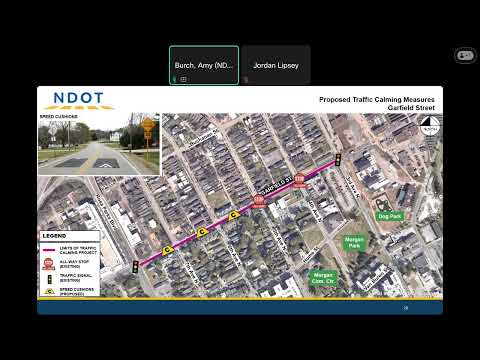
Birch said the project area runs on Garfield Street between Rosa Parks and Third Avenue and that a recent speed study found the 85th‑percentile speed at about 32 miles per hour and two‑direction traffic volumes near 3,500 vehicles per day. "That means 15% of the traffic is going above 32 miles per hour," Birch said, adding the department measured sidewalks on both sides of the street and an existing bikeway.
The proposed fix is three sets of rubber speed cushions, one cushion per lane, spaced about 300 to 600 feet apart on Garfield between Rosa Parks and Fifth Avenue. Birch said the cushions fit within existing 10‑foot lanes and were selected because they slow most passenger vehicles while allowing wider‑wheelbase emergency vehicles to straddle the gap. "We're really trying to slow vehicles down on residential streets," she said.
NDOT staff outlined other toolbox options used elsewhere, including speed tables (which span the full roadway), radar feedback signs, narrowed pavement markings, tightened corner radii (bulbouts) and traffic circles. Staff said cushions have produced reductions in measured speeds on other streets — for example, 85th‑percentile speeds falling from the high 30s to the mid‑20s and average speeds similarly dropping — and that the agency prefers cushions where lane widths and adjacent parking permit.
Staff described the program process and timeline: the conceptual plan will be converted to a detailed engineering plan in about six weeks; if no substantial rework is required, the project will go to an online ballot (postcard with QR code and unique ID) for six weeks; if the ballot passes it will enter the construction queue, which staff estimated at about eight to ten months after ballot approval. Birch said the ballot applies to property owners of parcels that abut Garfield (including eligible residences, churches and schools) and that each abutting property receives one vote. The ballot threshold is 66% of votes cast in favor for vertical measures to proceed, she said.
Funding and selection: Birch said Garfield was one of 25 streets selected last spring through the program's prioritization process and that the traffic‑calming program is funded from NDOT's capital budget subject to the Metro Council's annual budget approval. She said the program typically selects about 50 streets a year (two rounds of 25) while noting exact per‑street costs vary by length and treatment.
Residents raised concerns about several topics: potential traffic diversion to nearby streets (notably Fourth and Third avenues), driveway and future development access (a nearby development and food pantry were mentioned), the effectiveness of stop signs and existing signals, on‑street parking and corner sightlines. In response, Birch said NDOT would consider signal timing and driveway locations when producing the detailed plans, avoid placing cushions where a planned driveway would be located, and use the Hub (311) to address specific parking and sightline issues. She also reiterated that if the ballot fails, NDOT could still deploy lower‑impact measures such as signage or radar feedback signs rather than vertical devices.
Staff asked for additional input via the department's Engage Nashville page (engagenashville.gov) and said plans, recordings and final ballot results will be posted on trafficcalming.nashville.gov. Birch closed by saying she would remain available for follow‑up and listed the program email (n.trafficcalming@nashville.gov).
Next steps: NDOT will incorporate neighborhood feedback into the detailed engineering plan, confirm placement relative to driveways and new development access, prepare and mail ballots to abutting property owners, and publish final results online. No formal vote or City Council action occurred at the meeting; staff described the administrative ballot and subsequent construction timeline.