Get Full Government Meeting Transcripts, Videos, & Alerts Forever!
Get email alerts on the Transportation topic
No spam. Unsubscribe anytime.
City releases South Tyler Mobility Study with short-, mid- and long-term road recommendations
Summary
City staff and consultant HDR presented a South Tyler Mobility Study recommending intersection improvements, driveway consolidation, and prioritized new road alignments — including the Waldem Street Connector and New Copeland Road extension — to reduce congestion and crashes on Broadway Avenue.
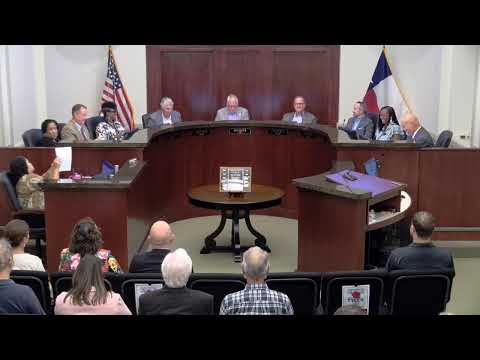
City of Tyler planning and transportation staff on Tuesday presented the South Tyler Mobility Study, a consultant-led analysis that recommends short-, mid- and long-term roadway improvements to ease congestion, reduce crashes and prepare for expected development in South Tyler.
The study, presented by Cameron Williams, traffic engineer for the city of Tyler, and Leslie Colic, project manager for HDR, identified Broadway Avenue as the corridor with the city—s highest traffic congestion and recommended a mix of cross-street improvements, driveway consolidation and new roadway alignments to provide alternate routes and improve safety.
The study team said short- and mid-term intersection improvements at five locations (Grande, Southtowne, Heritage, Cumberland and Centennial Parkway) would add turn lanes and allow optimized signal timing; those measures are estimated to reduce average intersection delay by about 16% and yield an annualized delay savings the presentation marked at $600,000, with a projected payback within seven years. The team also recommended consolidating or relocating private driveways along Broadway to add turn lanes; HDR estimated that driveway consolidation could cut crashes on the corridor by roughly 31%, equivalent in the presentation to an annual savings of about $2 million and a payback in under three years.
Long-term recommendations prioritize new or extended roadways over a 10-plus-year horizon. The study ranked the Waldem Street Connector as the highest-priority route because it provides a critical connection that relieves Broadway; the presentation said the single connector segment could reduce delay network-wide by about 7%, with an annual delay-savings estimate of $1.2 million. An extension of New Copeland Road was projected to reduce network delay by about 30%, with an annual savings figure shown as $7.8 million.
Leslie Colic said the study evaluated 12 roadway scenarios and used a prioritization framework that weighed traffic operations (60% of the score), environmental constraints, stakeholder impacts, benefit-cost measures, connectivity and active-transportation objectives. The study team recommended pursuing preliminary engineering for prioritized long-range alignments, preserving right of way and coordinating improvements with private developers and TxDOT, which has its own Broadway Avenue plans.
Williams said some short-term projects are already included in the city—s capital planning tiers and emphasized that many improvements will require partnerships with property owners and future developers. Asked about business owners— reactions to proposed access-management changes, Colic said early stakeholder engagement focused on property owners impacted by alignments and that the next step is forming a business-owner group to develop buy-in for driveway consolidation and cross-access arrangements.
Council members and staff framed the plan as a multi-year program rather than a single fix. Kyle Kingman, planning director, noted the corridor—s commercial development pattern and the study—s role in guiding future growth. The presentation closed with a recommendation to hold a public open house to solicit broader feedback.
The study materials on file with the planning department include the project—s short-term improvement concepts, prioritized long-range alignments and the stakeholder-engagement plan. The council did not take formal action on the study at the meeting; staff indicated next steps would include public outreach and preliminary-engineering work for prioritized roadways.