Get Full Government Meeting Transcripts, Videos, & Alerts Forever!
Get email alerts on the Youth Health Survey topic
No spam. Unsubscribe anytime.
Wallingford staff report declines in student substance use but highlight mental-health and help-seeking gaps
Summary
District staff told the Board that high-school substance use fell between 2023 and 2025, while persistent sadness, self-harm attempts and low help-seeking from school staff remain concerns; the presentation outlined prevention programs and recommended outreach to increase middle-school survey participation.
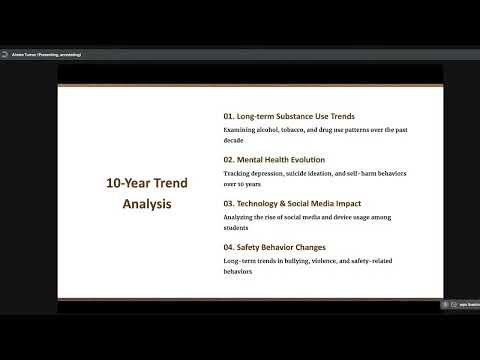
Mrs. Turner, district staff member, presented results from the Wallingford Youth Risk Behavior Survey to the Wallingford School District Board of Education, reporting declines in student substance use between the 2023 and 2025 administrations while flagging continuing mental-health challenges and low help-seeking from school staff.
The results cover high school students only this year because, the presenter said, board policy requires parental opt-in for middle school surveys and participation was too low to yield reliable middle-school data. Mrs. Turner reported that 940 high school students — about 57 percent of the high school population — completed the survey.
The data showed reductions in recent 30-day substance use: alcohol use fell from 12.1 percent to 8 percent, marijuana from 8.2 percent to 5.9 percent, vaping from 8 percent to 6.2 percent and binge drinking (defined in the presentation as five or more drinks in a 30-day period) from 5.1 percent to 3 percent. Cigarette use declined from 1.2 percent to 0.8 percent.
Despite those declines, the district highlighted mental-health concerns: 23 percent of surveyed students reported persistent feelings of sadness or hopelessness (occurring more than five times in a week, per the presentation). Mrs. Turner said 8.8 percent of respondents reported having hurt themselves in an attempt to end their life; she added that 88 percent of students who reported attempting self-harm did not seek support before the attempt. Of students who did seek help, the presenter said most turned to family or friends; only 0.3 percent reported asking a school nurse and 1.2 percent reported asking a teacher or counselor.
The presentation also addressed risky driving and device use: more than 90 percent of students report wearing seat belts, but Mrs. Turner said 42.1 percent of responding seniors reported using a phone while driving (which the survey did not distinguish as hands-free or handheld) and 30.1 percent of seniors reported texting while driving. She reported 2.2 percent of responding seniors said they had driven after drinking.
Bullying and dating-violence items also showed decreases on several measures between 2023 and 2025, per the presentation. For example, reported bullying on school property fell from 16.6 percent to 14.7 percent; cyberbullying declined from 13.4 percent to 12.1 percent. A slide in the presentation showed reported harassment of students identifying as gay, lesbian or bisexual declining from 32.6 percent to 8.5 percent.
Mrs. Turner reviewed prevention and support programs the district said contributed to the trends: expanded mental-health screening and early-intervention work, school-based counseling partnerships (the presentation named Connecticut Behavioral Health and Child Guidance programs), trained staff and community members in QPR (Question, Persuade, Refer), the SOS (Signs of Suicide) curriculum in middle school, CBITS (trauma-focused cognitive behavioral interventions), Bounce Back for younger children, a LEAP (learner engagement attendance program) for basic needs support, the Columbia Screener for risk identification and a drug-free community grant supporting prevention work with partners including the town health department and the Wallingford Police Department.
Board members asked for clarification on several points during and after the presentation. When a board member asked whether phone use while driving was hands-free, Mrs. Turner said the survey did not distinguish hands-free from handheld use and emphasized that novice drivers are prohibited from phone use under current rules for new drivers. Board members suggested the district produce parent-facing communications summarizing the results and the supports available; Mrs. Turner and staff said a district newsletter item and a possible special issue are being prepared.
The presentation closed with the district recommending continued emphasis on prevention programs, expanded mental-health services, efforts to increase students— help-seeking from school staff and a review of communication strategies to increase middle-school parent opt-in participation for the next administration of the survey.