Get Full Government Meeting Transcripts, Videos, & Alerts Forever!
Get email alerts on the Traffic Safety School Access topic
No spam. Unsubscribe anytime.
Oshkosh council rejects signal at Traeger School after neighbors raise safety and property concerns
Summary
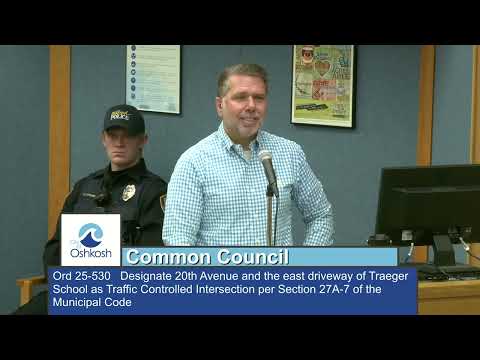
The Oshkosh Common Council voted against ordinance 25-530 to designate Twentieth Avenue and the east driveway of Karl Traeger School as a signalized intersection after neighbors raised concerns about property values, pollution and crash patterns.
The Oshkosh Common Council voted against ordinance 25-530, a proposal to designate Twentieth Avenue and the east driveway of Karl Traeger School as a signalized intersection.
Neighbors who live next to the school urged the council to reject the signal. Lisa Cobley, who said she lives at 2950 West Twentieth Avenue, told councilors, “We are the next house located next to Karl Traeger, and we do not want the light installed. We don't think that it's beneficial for the neighborhood. We simply don't want it.” She said she had consulted local real estate professionals who estimated a “2% to 5%” reduction in value for homes located very close to a traffic light and cited studies asserting increased particle concentrations and changes in crash patterns near signals.
City and consultant representatives said the signal was intended to address heavy queuing during school drop-off and pick-up. A representative identified in the meeting as John, a member of the traffic analysis team, told councilors the primary problem the signal seeks to solve is “the pickup and drop off time for parents” and, specifically, long delays and queueing that make it difficult to turn left out of the driveway. He said the team evaluated alternatives — including roundabouts and split driveways — and concluded a traffic signal was the best fit “from a cost standpoint and right-of-way standpoint.”
Nate Einstein of Bray Architects, who identified himself as working with the school district, said traffic at the site sometimes “back[s] up onto Twentieth Avenue,” and that the proposed changes would create additional queuing length on site and an additional turn lane to reduce that overflow.
The traffic analysis cited crash-modification factors the consultant summarized as an expected 34% reduction in right-angle crashes and a 14% reduction in all crashes, while noting a potential increase in rear-end crashes. Opponents pointed to that tradeoff; Cobley cited a University of Kentucky engineering report and a separate TADI summary saying right-angle crashes would decrease but rear-end collisions could rise.
Council discussion reflected mixed views. Council members said they appreciated staff and consultants’ work but differed on whether the signal is the right response now. One councilor said the plan appeared to be “a solution looking for a problem” and noted the impact on a business and a nearby residence. Another council member said the city should “get out in front of it” given expected enrollment-driven growth at the school and indicated support for the signal.
At roll call the clerk recorded individual votes; the clerk later stated the ordinance lost (announcement in the meeting: “Lost. 0 3”). The transcript records some recorded roll answers (for example, the clerk recorded Spannbauer as “No”), but the full name-by-name tally was not unambiguously transcribed.
The council chair also confirmed the ordinance before them was limited to designating the location as a signalized intersection and would not, by itself, prevent the school from pursuing other in-site construction or operational changes under separate approvals.
Several residents and council members urged broader outreach and more detailed coordination with the business directly across Twentieth Avenue; speakers said that business had not been fully consulted about the operational impact. City staff responded that notice was provided through the city’s standard processes and that the school district had held at least one meeting for families after a referendum.
The council moved on to other agenda items after the vote.