
Port Orchard finance committee reviews $9.5 million mid‑biennial budget amendment, highlights Bay Street funding and staffing requests
Get AI-powered insights, summaries, and transcripts
Subscribe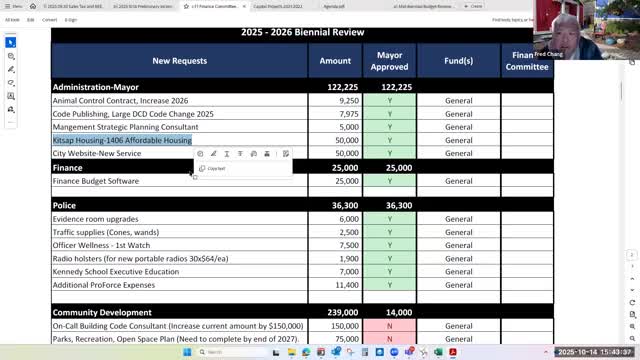
Summary
Port Orchard finance staff on Oct. 14 presented a proposed mid‑biennial budget amendment that would increase budgeted revenues and expenditures by $9.5 million and advance several capital projects, staffing requests and accounting “clean‑up” items ahead of council review.
Port Orchard finance staff on Oct. 14 presented a proposed mid‑biennial budget amendment that would increase budgeted revenues and expenditures by $9.5 million and advance several capital projects, staffing requests and accounting “clean‑up” items ahead of council review.
The proposal calls for using one‑time revenue and fund balances to cover new operating and capital needs while preserving reserve set‑asides. Mayor Rob Constant described the largest planned expenditure as fully funding the Bay Street reconstruction project, saying, “The largest expenditure in this proposed budget is to fully fund the Bay Street reconstruction project with our local dollars with the exception of $2,000,000 in KRCC funding.”
Why it matters: the amendment affects multiple funds, shifts impact‑fee proceeds into near‑term construction work and carries implications for reserve policies and staffing costs. Finance Director Noah Crocker told the committee the packet includes cleanup items — already authorized contracts and timing adjustments — plus new requests from department directors.
Crocker opened the meeting by noting modest sales‑tax performance and stronger REIT collections, and flagged a proposed capture of $300,000 of sales tax overperformance to apply to the 2025 budget amendment. He told the committee the amendment reflects updated information from Kitsap County on the maximum property‑tax levy the city can set for 2026 and that revenue estimates used to set the levy lag actual receipts by roughly 60 days.
The package would increase both revenues and expenditures by $9.5 million. Major capital items include: an $11 million estimate for the SR‑166 (Bay Street) reconstruction project; approximately $3.6 million from transportation impact fees proposed for Bay Street; $384,000 for the water work within that corridor to be covered temporarily from the general fund because the water operating fund lacks sufficient balance; and a $515,000 storm component. The packet also itemizes $129,000 in park impact fee spending for the community event center design work.
On storm and culvert work, staff said the Ruby Creek culvert design estimate has risen from about $450,000 to roughly $700,000 (an added $250,000), with 85% of that design funded by the Recreation and Conservation Office grant and 15% local match. An Annapolis Creek culvert design is also included with up to $500,000 in grant funding and a 15% local share, paid from the storm capital fund.
Public works Director Dennis Ryan and Crocker highlighted a $270,000 request for hydrogeology and mitigation work tied to the Foster-related water‑rights mitigation process; Ryan said the money is intended to bring the city “to the finish line” with hydrologic work and tribal and regulator negotiations that staff view as securing water supply for decades. Crocker and Ryan discussed accounting treatment and whether those consultant costs qualify as capital versus operating expenditures; staff said they are researching auditor guidance.
Staffing and operating requests: the amendment includes multiple position requests across departments. The police department asked for three officers (including vehicles and equipment) but the amendment funds one patrol officer; community development and public works seek several additions to plan review, inspections and field crews; the mayor proposed adding a 0.6 FTE communications/clerk position to handle public records and website content; and finance flagged a modest increase in payroll cost allocations. Crocker said positions that are funded from the general fund are paired with a three‑year salary set‑aside to help the city absorb a potential economic downturn.
Fund balances and policy questions drew sustained discussion. Council member John Morrissey pressed for clearer presentation of end‑of‑biennium balances and what minimum thresholds the committee should expect. Crocker recommended distinguishing capital funds (which often are drawn down when projects proceed) from operational funds, where declining balances are a greater concern. Crocker told the committee the general fund projected ending balance shown in materials was about $9.8 million, of which roughly $3 million is earmarked for working capital and roughly $2 million is being proposed as a personnel set‑aside for 2027–28.
Committee members asked staff to prepare a clearer, fund‑by‑fund mapping of new expenditures to their revenue sources (new revenue vs. fund balance) for the council work‑study next week. Council member Fred Chang and others asked for simpler “one‑page” rollups for council members that show the proposed changes and the funding source for each requested item.
Other items in the amendment packet: true‑up of previously approved contracts (library roof, EV chargers, retainage releases); a proposed $50,000 website modernization allocation; an evidence‑room and equipment requests for police; vehicle and ER&R (equipment replacement) adjustments including a proposed bucket lift truck in place of a planned hook‑lift unit; additional deicer/brine equipment; funding for design and master‑planning at Givens Park ($150,000 requested); and technology evaluations for planning permit software (SmartGov vs. Camino) and utility payment integration.
Revenue adjustments and timing: Crocker noted sales‑tax receipts reported in September reflect activity roughly two months earlier and that REIT receipts have outperformed 2024 and the current budget assumptions. He said the city is “truing up” revenues for storm fees after last year’s rate change and is incorporating a county‑provided maximum levy estimate into the 2026 property tax forecast.
Next steps: the committee asked staff to refine documentation for the full council work‑study the following week, and to include a one‑page summary mapping each proposed expenditure to its funding source. Crocker said the council will hold a public hearing on revenue sources in the coming weeks that leads into the formal property‑tax levy setting and the mid‑biennial amendment adoption process.
Quotes are from committee members and staff during the Oct. 14 finance committee meeting and reflect discussion and proposals under consideration by the City of Port Orchard. The committee did not record any final votes on the amendment at the Oct. 14 meeting.
What’s next: the finance committee will reconvene the presentation for the full council work‑study, and staff will present a revised packet that clarifies fund impacts and source‑of‑fund detail before council action on revenue and the mid‑biennial amendment.