Get Full Government Meeting Transcripts, Videos, & Alerts Forever!
Get email alerts on the Open Space Governance topic
No spam. Unsubscribe anytime.
El Paso City reconstitutes Open Space Advisory Board under resolution; bylaws standardized, meetings cut to quarterly
Summary
City staff and the city attorney briefed the Open Space Advisory Board on City Council's changes to how advisory boards are governed: the board was removed from city code and reestablished by resolution, unified bylaws will take effect after a city council action, meetings will move from monthly to quarterly, and support staff coordination will be
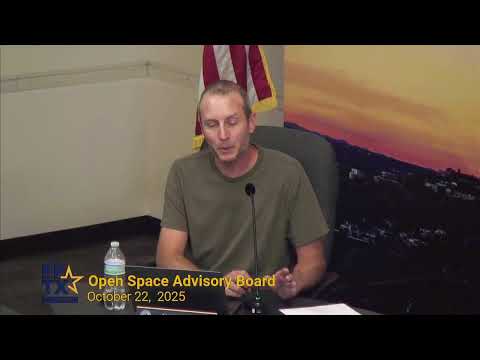
City staff and the city attorney told the Open Space Advisory Board that City Council has reconstituted the board by resolution and adopted uniform bylaws that change how non-state boards are governed.
The change, staff said, removes boards that are not state-mandated from the city code and places them under resolution so the council can amend them more easily. "The unified bylaws are gonna be, come effective at Tuesday's city council meeting," said Russell Abelin, assistant city attorney.
City staff said the most visible operational changes for the Open Space Advisory Board include a shift from monthly meetings to quarterly meetings and a standard meeting calendar. "City Council decided to have the board meet 4 times a year," a staff presenter said. Staff also described a transition of day-to-day liaison work from Planning & Inspections to Parks and Recreation, while planning staff will continue to provide support as needed.
Board members and the attorney discussed several policy details that affect the board's authority and operations. Under the adopted materials: the board is explicitly advisory and will provide an annual report to City Council each August; bylaws and training (ethics, Open Meetings Act, public information) will be standardized; attendance rules will be stricter (removal for three consecutive absences or under 60% attendance); terms will be aligned to start Sept. 1 and end Aug. 31; and quorum was set at five members under the new bylaws.
Board members pressed staff on the board's purview. Several asked whether trails and trailheads fall under the board's remit. The staff response was that the board's purview centers on "open space as identified in the current open space master plan" and that, in staff's reading, trails and trailheads are elements of open-space usage that can fall before the board. Board members also sought clarification about how the board would receive acquisition items and whether acquisitions would automatically require closed sessions. Staff reiterated that closed sessions for land acquisition require City Attorney sign-off and that acquisitions typically come forward only after City Council identifies funding.
Russell Abelin said uniform bylaws will include a training program for new board members and board liaisons and that the clerk's office is standardizing agendas and public-facing materials. He said the changes aim to reduce dormant boards, improve quorum reliability and simplify future amendments.
Board members recommended small wording changes and flagged potential contradictions between the unified bylaws and other guidance (for example, a general rule elsewhere that advisory boards do not hold closed sessions vs. this board's explicit exceptions for acquisitions). Abelin acknowledged the concerns and said the reestablishment by resolution was intended to allow tailored exceptions where justified.
Board members said they will expect continued staff follow-up with clarified language and training materials so the board and council appointees understand limits and expectations.
Ending: Staff said the new bylaws and training materials will appear on the city's website and will be rolled into the standard onboarding for new appointees; the board will receive a more detailed training presentation at a future meeting.