Get Full Government Meeting Transcripts, Videos, & Alerts Forever!
Get email alerts on the Budget topic
No spam. Unsubscribe anytime.
Council opens 2026 budget public hearing and studies operating funds; staff projects $27.6 million in expenditures
Summary
At an Oct. 7 meeting the Newcastle City Council opened a public hearing on the preliminary 2026 budget and held a detailed budget study session; Finance Director Chambers presented a $27,593,714 preliminary expenditure total and staff walked council through revenues, personnel changes and fund-level adjustments.
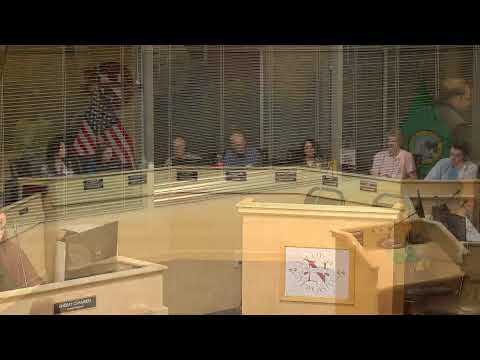
The Newcastle City Council opened a public hearing on the proposed 2026 budget on Oct. 7 and then held an extended budget study session that reviewed operating funds, revenue drivers and notable changes from the current year.
Finance Director Chambers presented the city’s preliminary 2026 expenditure total for adoption consideration as $27,593,714 (expenditures only). She described the budget breakout as: operating $16,726,367; capital $6,356,953; debt service $469,447; interfund transfers $3,640,947; and other financing uses $400,000. Chambers said the budget book had been posted and staff welcomed public testimony and council questions.
Two residents spoke during the public hearing urging the council to add the Lake Boren Promenade to the capital improvement program and to apply for a $1 million Recreation and Conservation Office (RCO) grant in early 2026. Gary Campan, speaking for Newcastle Trails, described the promenade as an ADA-accessible waterfront path that would expand Lake Boren Park North and complete a lakeside trail. Peggy Price said the grant opportunity is offered roughly every two years and urged the city to use modest local matching or preliminary funding to qualify.
At the subsequent study session, City Manager Pingel and Director Chambers walked council members through major operating assumptions and line-item changes. Key staff notes and assumptions presented to the council included:
- Salaries and benefits: a 2.7% cost-of-living adjustment (COLA) for nonrepresented and union employees; the city’s step system remains in place (each step ~3% for eligible employees). The budget adds 0.2 full-time equivalents by converting a 32-hour events and recreation coordinator to full time.
- Employer pension (PERS) rates: the state legislature’s reduction in the employer PERS rate produced a projected benefit-cost decrease in the city’s budget.
- Revenues: staff explained property-tax mechanics and said the 1% allowed levy increase equals $64,857; new-construction property-tax growth was preliminarily estimated at $75,580 (staff said King County updates may increase that estimate). Chambers explained that Newcastle’s levy rate is a portion of total property tax bills and that the city’s share of a typical home’s taxes remains a little over 12% of the total.
- Sales tax: staff reported strong construction and retail sales-tax receipts in 2024–25 and increased the 2026 sales-tax projection accordingly. Staff noted the effect of online sales tax distribution and that sales taxes are assigned by municipal tax codes rather than ZIP code alone.
- Development fees and permit revenue: staff projected permit-related revenue around $550,000 and cautioned about timing mismatches between fee receipts and related project expenditures; they noted large-track development sites in the city are limited.
- Service and capital funds: staff reviewed expected interfund service-charge allocations, the street fund’s reliance on transfers from the general fund (a placeholder transfer up to $597,000 was shown), and stormwater (SWIM) fund needs including scheduled replacements and a required National Pollutant Discharge Elimination System (NPDES) update and associated additional inspections.
Specific line items discussed included an increase in police contract costs (King County estimate supplied to staff was within $4,000 of the council briefing projection), and an 11% increase to the Bellevue Fire contract. Staff also proposed adding $50,000 to hazard-tree removal and a $63,000 replacement for storm filters in the SWIM fund, which staff said is typically a 5–7 year replacement cycle. The storm-filter and tree-removal costs are one-time or project-driven items.
Staff also noted the SWIM fund’s recommended swim-fee schedule from a prior analysis: the preliminary budget assumes a 3% annual utility-fee increase (as recommended by the utility study) but noted the council would need to adopt any fee ordinance. "My preference would be to adopt a budget with the 3% in there, and if we adopt a budget with the 3% in there, then we'll bring the council an ordinance to increase the rate," the city manager said.
Councilmembers asked clarifying questions about the budget slides and staff agreed to publish memos documenting changes as the council’s budget work continues. Staff said the next study session will cover capital project funds and internal-service funds and that the council will receive updated King County new-construction numbers when available.
What’s next: The council will continue budget study sessions, receive updated property-tax and new-construction figures from King County, and consider fee ordinances if the council elects to adopt the swim-fee increase. Staff will also post follow-up memos and answer council questions prior to final budget adoption.
Public comment excerpts: Gary Campan (Newcastle Trails) urged adding the Lake Boren Promenade to the CIP and pursuing a $1 million RCO grant; Peggy Price (Wintree) said the grant recurs about every two years and urged the city to apply. Both asked for a CIP priority for the promenade and early application funding.