Get Full Government Meeting Transcripts, Videos, & Alerts Forever!
Get email alerts on the K 12 Curriculum Pathways topic
No spam. Unsubscribe anytime.
Marshall Middle School expands hands-on Pathways courses to boost career exposure
Summary
Middle school teachers described recent additions to the Pathways program — including a medical lab, hotel/hospitality and floral-design activities — and said grants funded new materials. Teachers said classes connect students to careers and build practical skills before high school.
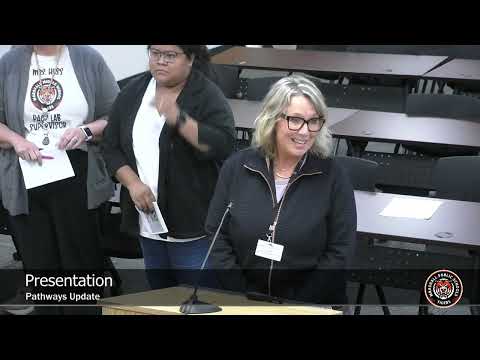
Marshall Middle School teachers updated the Marshall Public School District board on recent expansions to the school’s Pathways program, outlining new hands‑on modules intended to expose students to career areas and prepare them for related high‑school coursework.
The Pathways update, presented at the district office, drew on staff from multiple disciplines who described quarter‑long courses that rotate students through job‑style activities in agriculture, family and consumer sciences, Spanish, and PACE‑style career labs. “There is a career for somebody. It’s not just working on a farm or working at a plant,” said Leah Butel, seventh‑grade agriculture teacher, describing plant science, animal science, and agricultural technology modules that include soil testing and small manufacturing projects such as leather fobs and pickles.
The program’s designers emphasized that the courses are intentionally short and exploratory. Laura Morris, family and consumer sciences teacher, said sixth‑graders take a quarter of foods, personal finance and character/relationships before repeating a more advanced quarter in seventh grade. Morris described activities that teach kitchen safety, budgeting basics and introductory sewing, and said recent grant funding allowed the purchase of sewing machines for classroom use.
Sarah Runck, eighth‑grade Spanish teacher, said the district now requires an exploratory Spanish quarter for all eighth graders and offers an advanced Spanish option for heritage speakers. “Students go from not having any experience with Spanish to reading a novel by the end of the quarter,” Runck said, noting cultural projects, language games and presentations that aim to develop both oral and literacy skills.
Erica Hess, an eighth‑grade PACE teacher, described the middle‑school PACE lab as unique to Marshall, noting new jobs added to the curriculum such as a medical lab station, cosmetology (hair and nails styling, not cutting), hotel and hospitality simulations, graphic design tasks and a floral design activity being pilot‑tested with community help. Hess said community experts have provided subject knowledge and that grant funding covered the cost of the new materials: “None of the new additions have cost our school any money,” she said.
Teachers said the Pathways courses are intended to build practical skills, foster collaboration among students who might not otherwise work together and create clearer pathways into high‑school CTE (career and technical education) classes. Presenters repeatedly linked the classes’ existence to outside funding and community partnerships; when materials arrive, staff must design the learning tasks and train with local experts, they said.
Board members and presenters did not propose any immediate policy changes; the presentation was informational. Staff members invited questions and said they will continue to seek grant support and community partners to expand opportunities.