Get Full Government Meeting Transcripts, Videos, & Alerts Forever!
Get email alerts on the Sanitation topic
No spam. Unsubscribe anytime.
Elyria Council weighs future of city sanitation after route, financial studies
Summary
Council members and city staff reviewed a route study, an updated financial analysis and private-sector bids for sanitation services; no vote taken — council scheduled further review and a consultant presentation before possible action.
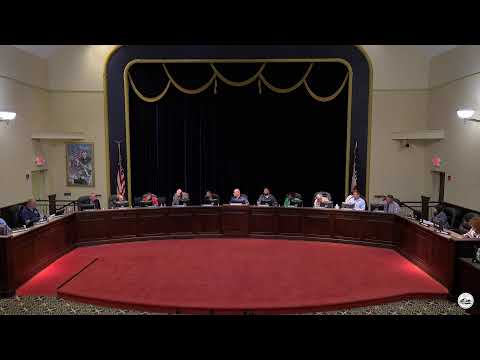
Elyria City Council members spent the evening examining a months‑long review of the city’s sanitation operations and bids from private contractors, with no formal action taken. Council President Stewart opened the strategic‑planning discussion by saying the review was “just for discussion only” and that the goal was to understand whether privatization or internal reforms would better preserve service and finances.
Safety Service Director Pajanowski reviewed three components the city commissioned: a route analysis by RouteWare, an updated financial study originally done by REA Associates in 2018, and formal bids solicited from private haulers. Pajanowski said the RouteWare work produced two feasible route scenarios: one that would keep residents’ pickup days unchanged and balance loads internally, and another that would shift about 10% of customers (roughly 1,650 households) to new collection days and allow the city to eliminate one garbage route, one recycling route and half of a bulk route on certain days.
Pajanowski said the updated financial analysis modeled capital needs (he asked consultants to include roughly $400,000–$450,000 per year to replace trucks) and found the sanitation fund would require ongoing increases to remain sustainable. He told council that in 2024 Elyria disposed of “over 22,000 tons of solid waste and 675 tons of recycling,” and that REA’s updated recommendation to sustain the department was roughly 5% year‑over‑year rate increases.
Pajanowski summarized the budget effects of a 5% annual increase: “If we increased the rate by 5% in 2026, it’d be an increase of a dollar 67 a month to a total of $35.05. In 2027, it’d be … $36.80,” and he repeated consultant modeling showing multi‑year projections. He also said curbside recycling is significantly more expensive per ton than landfill disposal — roughly $100 per ton for recycling versus about $59.59 per ton for solid waste — and noted contamination fees when recycling loads exceed accepted contamination thresholds.
Several council members pressed on cost drivers and hidden offsets. Councilmember Tillett flagged that roughly 25% of several administrative positions’ salaries (mayor’s office, law, finance and others) have historically been charged to the sanitation fund and warned that shifting to a private contractor could move roughly $400,000–$500,000 in costs back to the city’s general fund. Director Pajanowski confirmed some salary splits had already been reduced in recent years but said additional shifts would likely be necessary if the city eliminated internal sanitation operations. Finance director Pawlowski answered budget questions and said wages and benefits accounted for a large share of the sanitation budget.
Councilmembers debated service quality, equity and the department’s broader municipal role. Multiple members and the mayor spoke in support of retaining the in‑house crew, citing responsiveness and the difficulty of quantifying value: “they provide a service that’s important to the city,” Pajanowski said of sanitation employees. Councilmembers also proposed ideas to reduce costs or improve recycling participation, including quarterly or neighborhood recycling centers, education and incentive programs and stricter enforcement of bulk and contamination rules.
Pajanowski said the city’s solicitation for privatization had been written to match current services closely (weekly garbage and weekly unlimited bulk pickup, recycling, and certain “backdoor”/assisted services) so bids would be directly comparable. He noted private bidders would be expected to purchase carts so the city would not have to supply roughly 17,500 containers.
Council did not vote on privatization or on rate changes. Members asked staff to supply additional detail on any transfer of administrative costs back to the general fund, and President Stewart and director Pajanowski said the consultant who produced the route and financial reports would return for a detailed presentation at the November 17 meeting. Stewart said council intends to make a decision after that presentation.
Ending: Council left the matter open for further analysis and scheduled a consultant presentation and continued discussion; no policy change or formal transfer of services occurred at the Oct. 20 meeting.