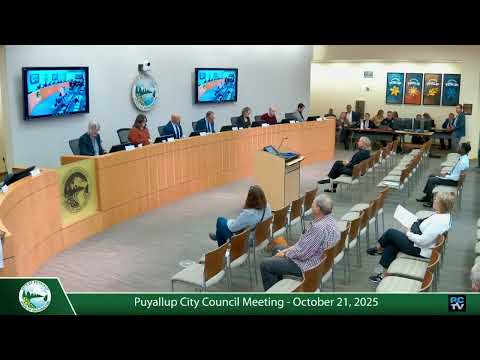
Puyallup council approves ordinance implementing Washington's co‑living law; planning commission adds bathroom requirement
Loading...
Summary
After public comment and council debate the Puyallup City Council voted to adopt an ordinance implementing Washington State House Bill 1998 to allow "co‑living" housing where multifamily housing (6+ units) is permitted; the Planning Commission added a requirement that each sleeping unit include a sink, toilet and shower.
The Puyallup City Council on Oct. 21 approved second reading and final passage of an ordinance to implement Washington State House Bill 1998, which requires local jurisdictions to allow "co‑living" housing in any zoning district where at least six multifamily residential units are permitted.
Katie Baker of the planning division summarized the state requirement and the staff analysis, telling the council, "House Bill 1998 requires that co living housing be allowed on any lot where at least 6 multifamily residential units are allowed." Baker walked the council through city land‑use designations that would be affected, including high density residential, mixed‑use and downtown pedestrian commercial zones, and noted where removing multifamily uses would threaten the city's capacity to meet adopted housing targets and threaten regional growth center designations.
The Planning Commission added a locality‑specific definition to the city code prior to council consideration: each sleeping unit must include a bathroom with at minimum a sink, toilet and shower. Baker said that change increases construction costs and may affect the number of development proposals, but that the commission's amendment improves privacy and habitability compared with configurations that would rely exclusively on shared facilities.
Public comment and council debate: During public comment local resident Vera Glace urged the council to resist the change and said co‑living would bring density and policing concerns; Councilmember reactions varied. Councilmember Gilliam, who said she had firsthand experience living in shared‑house arrangements, described co‑living as a possible lower‑cost option for young adults and students and said she thought the number of developments likely to be built in Puyallup would be limited. Councilmember Dean Johnson said he opposed the state mandate in principle but voted to approve the ordinance because most of the city would not be affected and the Planning Commission's bathroom requirement raised the quality bar.
Vote and outcome: The council approved second reading and final adoption by roll call. The clerk recorded unanimous aye votes from councilmembers present: Whiting, Dorff, Adler, Johnson, Deputy Mayor King, Gilliam and Mayor Jim Castellan (roll call recorded on the transcript as "Aye").
Why it matters: The ordinance implements a state law that standardizes where co‑living is allowed across jurisdictions and limits local discretion. Baker told the council the most impacted zones are the city's higher‑density and mixed‑use areas downtown and in South Hill; lower‑density neighborhoods and most single‑family areas will not be subject to the change. Several councilmembers said they viewed the change as an experiment that should be monitored and that the Planning Commission's bathroom requirement would likely reduce incentives for marginal, low‑amenity conversions.
Next steps: The ordinance will be incorporated into the municipal code. Staff said additional zoning or comprehensive plan amendments would require separate processes if the council decides to pursue narrower local limits (some changes would require a comprehensive plan amendment and a once‑a‑year schedule). Councilmembers asked staff to monitor outcomes and return with data if conversion or nuisance complaints appear.
Ending note: Councilmembers emphasized a desire to preserve neighborhood character while complying with state law and to encourage pathways to ownership where feasible.