Get Full Government Meeting Transcripts, Videos, & Alerts Forever!
Sedro-Woolley planning staff lays out toolbox of zoning and incentives to address housing shortfall; commissioners warn of costs, infrastructure limits
Summary
Sedro-Woolley planning staff on Oct. 21 presented a combination of zoning changes, tax‑exemption options, grant strategies and site candidates meant to close a projected shortfall of housing affordable to very low‑income households included in the 2025 comprehensive‑plan housing element.
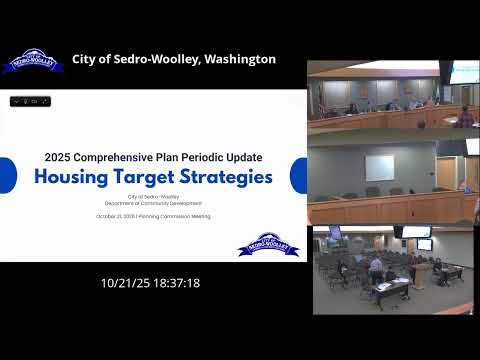
Sedro-Woolley planning staff on Oct. 21 presented a package of zoning changes, financial incentives and site-specific options intended to close the city’s shortfall of housing affordable to very low-income households as part of the 2025 comprehensive-plan update.
Planning staffer Nicole, leading the presentation, told the Planning Commission that the city’s housing analysis shows a large deficit for households at 0–30% of area median income (AMI). She said the analysis identifies a need for 741 units in that lowest AMI band over the next 20 years, with current capacity at 88 units and a resulting deficit of 653 units.
“There is no single policy that will sustainably provide all of the housing deficit and all of the income bands,” Nicole said. She outlined a “toolbox” of regulatory and financial strategies the city could include in the housing element and later the development code to pursue a mix of solutions.
Why it matters: Sedro-Woolley must adopt a comprehensive-plan housing element that responds to recent state law changes and to the Growth Management Act requirements. The planning staff presentation maps how zoning changes, incentives such as the multifamily tax exemption (MfTE), grants and publicly leased land could be used together to expand affordable units — especially for the 0–30% AMI cohort, which staff identified as the hardest to serve.
What staff proposed: The staff slide deck and discussion covered three categories of actions:
- Zoning and…
Already have an account? Log in
Subscribe to keep reading
Unlock the rest of this article — and every article on Citizen Portal.
- Unlimited articles
- AI-powered breakdowns of topics, speakers, decisions, and budgets
- Instant alerts when your location has a new meeting
- Follow topics and more locations
- 1,000 AI Insights / month, plus AI Chat