Get Full Government Meeting Transcripts, Videos, & Alerts Forever!
Get email alerts on the Housing Comprehensive Plan topic
No spam. Unsubscribe anytime.
Sedro-Woolley planning staff lays out toolbox of zoning and incentives to address housing shortfall; commissioners warn of costs, infrastructure limits
Summary
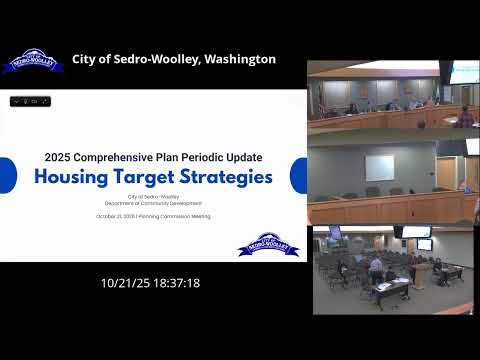
Sedro-Woolley planning staff on Oct. 21 presented a combination of zoning changes, tax‑exemption options, grant strategies and site candidates meant to close a projected shortfall of housing affordable to very low‑income households included in the 2025 comprehensive‑plan housing element.
Sedro-Woolley planning staff on Oct. 21 presented a package of zoning changes, financial incentives and site-specific options intended to close the city’s shortfall of housing affordable to very low-income households as part of the 2025 comprehensive-plan update.
Planning staffer Nicole, leading the presentation, told the Planning Commission that the city’s housing analysis shows a large deficit for households at 0–30% of area median income (AMI). She said the analysis identifies a need for 741 units in that lowest AMI band over the next 20 years, with current capacity at 88 units and a resulting deficit of 653 units.
“There is no single policy that will sustainably provide all of the housing deficit and all of the income bands,” Nicole said. She outlined a “toolbox” of regulatory and financial strategies the city could include in the housing element and later the development code to pursue a mix of solutions.
Why it matters: Sedro-Woolley must adopt a comprehensive-plan housing element that responds to recent state law changes and to the Growth Management Act requirements. The planning staff presentation maps how zoning changes, incentives such as the multifamily tax exemption (MfTE), grants and publicly leased land could be used together to expand affordable units — especially for the 0–30% AMI cohort, which staff identified as the hardest to serve.
What staff proposed: The staff slide deck and discussion covered three categories of actions:
- Zoning and form-based changes intended to increase infill capacity and “middle housing.” Staff proposed a new R10 residential zone allowing single-family homes with accessory dwelling units (ADUs), duplexes through four‑plexes, townhomes and cottage clusters; rezones to align adjacent R7 and R15 areas; expansion of Urban Village Mixed Use (UVMU) and Central Business District (CBD) boundaries in selected locations; and removing restrictive unit-count limits and lot-size barriers to make duplexes and small multi‑units more feasible.
- Financial incentives and regulatory incentives. Staff outlined three MfTE options (8-, 12- and 20‑year programs), noting the 20‑year MfTE would be most likely to support deeper affordability. Staff also discussed fee waivers or scaled reductions (impact and utility-connection fees), pre‑approved ADU plans to lower soft costs, and leasing publicly owned land to nonprofits or developers for permanently affordable projects.
- Grants and other funding tools. Staff reviewed state and federal sources including the state CHIP reimbursement for impact/connection fees, Community Development Block Grant (CDBG) programs (including Section 108 loan guarantees), and HUD’s HOME Investment Partnerships program as sources to subsidize 0–30% AMI housing.
Potential sites and scale: Planning intern Ian walked commissioners through candidate parcels. He told the commission a UVMU site could support up to 74 units affordable to 0–30% AMI under a 20‑year MfTE scenario — nearly doubling the city’s present capacity at that band. Ian also identified a “Hometown Pharmacy” mixed‑commercial parcel and the Benson property (R15‑zoned, undeveloped and owned by a party expressing interest in affordable housing) as higher‑opportunity, lower‑revenue‑loss sites. Staff reported the Port of Skagit (Swift Center) had expressed interest in workforce and senior housing in core influence areas, but noted the port is tax‑exempt so MfTE would not apply there.
State law and code changes noted: Staff referenced House Bill 1337 (requirements to allow two ADUs on lots that allow single‑family residences) and Senate Bill 5559 (lot subdivision/ownership rules that enable separate ownership of ADUs and townhouse units). They emphasized these state mandates must be reflected in the comprehensive plan.
Commissioners and public: Commissioners and attendees broadly endorsed exploring multiple tools, but they repeatedly flagged practical constraints — construction and utility hookup costs, high interest rates and resulting financing challenges, limited local infrastructure (water, sewer, road capacity), environmental/critical‑area constraints and the time lag between zone changes and new construction. Several commissioners cautioned that rezoning long‑established single‑family areas or expanding CBD zoning could create nonconformities that harm existing homeowners’ ability to sell or rebuild.
On feasibility, commissioners and participants stressed the economics: building costs, developer return requirements and lender concerns mean fee waivers or required inclusionary units can make projects unfinanceable unless coupled with strong incentives (for example, an MfTE program or grant subsidy). One commissioner summarized the tradeoffs as a question of “what we are willing to give up to get housing” — from street parking and open‑space tradeoffs to increased traffic.
Next steps: Staff said they will synthesize the commission’s feedback and return in November with a recommended package of comprehensive‑plan policies and a prioritized list of development‑code changes. Nicole told the commission the immediate recommendation will be for policy language in the comp plan; development‑code (regulation) revisions would come after the commission’s policy advice and later public hearings. The commission scheduled the next review for Nov. 18.
Votes and procedural items: The meeting opened with routine minutes approvals and closed with a motion to adjourn. No formal amendments to the comp plan or development code were made at the Oct. 21 meeting.
What remains unanswered: Staff and commissioners agreed the largest open questions are (1) how to finance deep affordability at 0–30% AMI at scale; (2) the timing and location of rezonings that will actually produce units (not just capacity on paper); and (3) the degree to which the city can use its own land and grants to reduce developer risk without creating a long‑term budget gap.