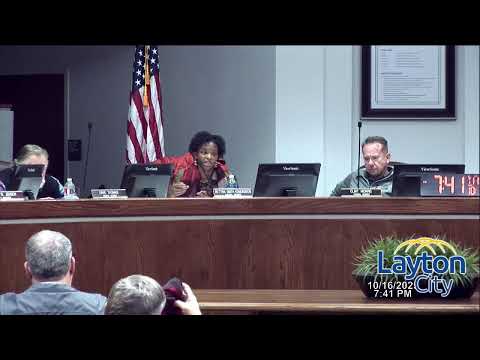
Layton staff present draft water element for city general plan, set public hearings
Loading...
Summary
City planners told the council the state now requires a water-use and preservation element in municipal general plans; staff outlined key objectives, existing city conservation work and recommended 'considerations' for landscaping, pools and certain high-water uses. Planning commission and city council public hearings were scheduled.
Layton City planners presented a draft “water element” for the city's general plan on Oct. 16, explaining the document responds to a state requirement that cities adopt a water-use and preservation element and outlining recommended considerations for landscaping, pools, development patterns and water-quality protections.
Planner Jeff Monagu, identified by staff as one of the project's lead planners, told the council the state requires adoption of a water element by Dec. 31 and that staff will present the draft to the Planning Commission on Oct. 28 and return to the City Council for a public hearing on Nov. 20.
The draft ties local land-use patterns to water demand and cites Layton's existing water-conservation work, including a 2022 water-conservation plan and a water master plan update currently underway. Staff said the city's current population is about 88,000 and projected to grow to roughly 110,000 by 2045, and that residential outdoor irrigation makes up the largest share of municipal use.
Monagu and other staff emphasized several categories of "considerations" rather than mandatory new regulations. Those considerations include expanding water-wise landscaping requirements beyond PRUD subdivisions, tightening turf rules for narrow park-strip areas, requiring pool covers on new pools, evaluating maximum pool sizes for single-family lots, and scrutinizing water-intensive land uses such as some data centers. Staff noted Weber Basin and other regional resources for turf-replacement rebates and water-wise plant lists.
On landscaping, staff reminded the council Layton adopted water-wise landscaping standards for some developments in 2021 but said the draft would give the city more tools to require water-efficient plantings when landscape areas are reinstalled or when commercial sites are being significantly renovated. Staff said Weber Basin provides technical support and rebate programs for turf replacement and other conversions.
On pools, planners showed permit data from 2024'25 and told the council that requiring pool covers on new pools could substantially reduce evaporation; staff also discussed using size limits as a tool to lower outdoor water demand in areas of larger lots.
The draft also addresses water-quality measures such as parking-lot runoff controls and riparian setbacks around local streams. Staff tied the local water element to the broader regional concern of Great Salt Lake levels, saying "conservation alone is not enough" and that regional cooperation will be needed to shepherd more water to the lake.
Council members asked about implementation details and exemptions for commercial remodeling and about the interplay between the draft element and existing landscape and development codes; staff said many specifics are being framed as "considerations" to allow flexibility and to avoid imposing new mandatory requirements without further council direction.
The council did not take formal action on the draft at the meeting; staff said it will go to the planning commission Oct. 28, then return to the council Nov. 20 for a public hearing and possible adoption.