Get Full Government Meeting Transcripts, Videos, & Alerts Forever!
Get email alerts on the Charter Amendment topic
No spam. Unsubscribe anytime.
City attorney says proposed 3% levy charter amendment cannot lawfully limit future levies; council declines putting question to voters
Summary
The International Falls City Council acknowledged a procedural defect in a 2024 charter amendment and voted to operate under the prior charter. The council also reviewed a citizen petition to cap the city levy at 3% and, after legal advice, voted not to place that amendment on the ballot.
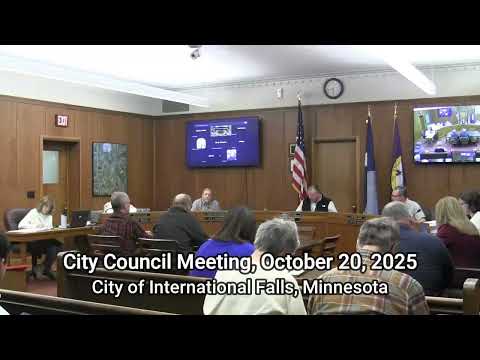
The International Falls City Council on Monday acknowledged that a 2024 attempt to amend the city charter was not “perfected” under state procedures and voted unanimously to operate under the earlier charter until the matter is resolved.
City Attorney Chelsea Nelson told the council that a required step — a public hearing between readings — was not completed when the city attempted the charter change. Nelson said the omission means the 2024 amendment was not perfected and the city should function under the prior charter unless the council chooses to cure the error by repeating the ordinance process.
Nelson also advised the council that a recent citizen petition asking to limit the city tax levy to 3% with narrow exceptions is not a legal ballot question. Nelson and the League of Minnesota Cities told the city the authority to impose a levy cap of that kind rests with the state Legislature, not a city charter or local petition. Nelson said the Attorney General would likely invalidate any successful local vote on such a question and cited Minnesota Statutes and a 1982 Attorney General opinion in support of that view.
The Charter Commission chair, Lois Lundeen, said the commission unanimously found the petition’s signatures sufficient and that the commission had sought an outside counsel opinion to review whether the 3% proposal could legally appear on a local ballot. Lundeen said the commission had forwarded the petition for administrative review and asked for clarity on next steps.
After discussion, the council voted 4-1 to acknowledge the Charter Commission’s certificate of sufficiency (that signatures met statutory requirements) but to decline to place the 3% levy amendment on the ballot. The council also approved a separate, unanimous motion to acknowledge the procedural defect in the 2024 charter amendment and to continue operating under the prior charter until the council decides to reenact or otherwise address the amendment.
The council left open the option to seek a second legal opinion; some councilors said they wanted time for the Charter Commission’s outside counsel to respond before taking further action. Nelson said delaying action a few days would not cause legal exposure, though she recommended at minimum a formal acknowledgment of the imperfection to avoid further uncertainty.
The council also discussed practical next steps, including the choices of reenacting the ordinance correctly, submitting the question directly to voters, or formally deciding to remain under the old charter. Nelson cautioned that reenacting would restart the statutory timelines and could again expose the city to referendum petitions.
The council’s votes on Monday leave the legal status of the 2024 amendment unresolved until the city either cures the procedural omission or pursues another course. Nelson said she was not worried about immediate litigation because the city’s prior good-faith reliance on the amended charter provides a legal protection, but she urged the council to document its interim position.