Lifetime Citizen Portal Access — AI Briefings, Alerts & Unlimited Follows
Nordonia Hills City School District reviews stability, facilities and technology sections of strategic plan
Loading...
Summary
At its Oct. 20 meeting, the Nordonia Hills City School District Board of Education reviewed the strategic planstability and optimization sections, including enrollment forecasting, a 25-year facilities master plan, technology investments and grant-seeking; the board announced it would move into executive session to discuss employee compensation.
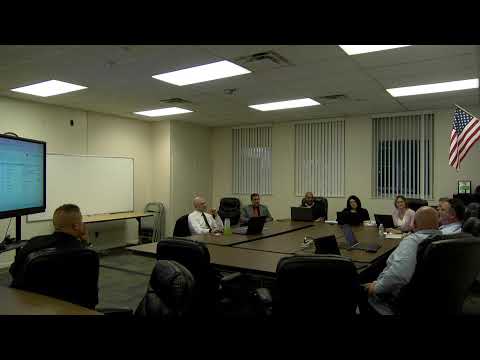
The Nordonia Hills City School District Board of Education on Oct. 20, 2025 reviewed the "stabilized" and "optimized" sections of its strategic plan, hearing staff presentations on enrollment forecasting, technology investments and a 25-year facilities master plan and announcing plans to enter executive session to consider the compensation of a public employee.
School finance and operations staff told the board the work is aimed at making long-term budgeting and capital planning more transparent and data-driven, and at identifying grant and sponsorship opportunities to reduce the district's reliance on the general fund.
District staff member Kyle, who led the presentation on the plan's stability elements, said the board will start its revenue and enrollment forecasting from state EMIS data and updated birth-rate inputs for Summit County, and will present a semiannual five-year forecast to the community. Kyle said the enrollment report uses multiple scenarios (low/mid/high) and additional local inputs such as voter-registration data to test assumptions. "I don't think these kids are coming," Kyle said, describing a case from a prior district where a new housing developmentwhen examined against voter-age datadid not yield the expected number of school-age children.
Kyle also reviewed recent and planned revenue-diversification efforts. He said roughly $23,000 in technology spending had been redirected away from the general fund, and he recapped a previously board-approved E-rate technology project that he said returned $226,000 to the district in the last five-year window. He told the board that under the Federal Communications Commission's E-rate rules the district expects a higher per-student reimbursement in the next cycle and estimated a roughly $274,000 reimbursement in the upcoming five-year window.
On technology planning, district staff member Mike described Chromebook replacement timing and the devices' auto-update-expiration (AUE) dates, noting the district's earliest expiring carts in kindergarten through grade 2 are scheduled for 2029. Mike said staff are moving procurement earlier in the year to smooth replacement costs. He also noted cybersecurity funding is not broadly available through E-rate: "Cybersecurity still is not part of the e rate funding for me," Mike said, adding that limited pilots have funded only a small number of districts nationwide.
Facilities and long-range planning were presented by district staff member Todd, who said the district is updating its Ameresco facility records and is moving into development of a comprehensive 25-year master plan. Todd said staff will meet with nine stakeholder groups over the next month and will incorporate data from the Ohio Facilities Construction Commission and other state reports. Letters inviting focus-group participants are due to go out the next day, he said.
Todd outlined several maintenance and capital priorities. New playground equipment at Northfield Elementary School has been installed with support from the Northfield PTA/TCA; mulch installation was pending. He said multiple baseball and softball fields require multi-year repairs, noting two fields had not been worked on since the stadium was built about 13 years ago and two others had gone roughly 10 years without maintenance. For athletic-field work he proposed a shared funding model in which boosters would cover roughly three-fifths of costs, with the remainder sought through sponsorships, grants or, if necessary, the district's MGM funds.
Staff described active grant-seeking and tracking. The district is pursuing or researching opportunities including county-level playground grants, the Hershey Foundation, an Ohio Department of Development energy-efficiency grant for boiler replacement, and a potential demand-response energy program run with CPOWER. Todd said the high school may meet the kilowatt-hour baseline needed to participate in the demand-response program; staff expect to know by January or February whether the school can qualify. To manage opportunities, staff maintain a live grant-tracking spreadsheet with amounts and status.
On building security, staff reported updated badges for new employees, monthly checks of the district's 249 cameras and planned tabletop exercises this school year to test response procedures. Staff said the district has scheduled biannual town-hall meetings and additional community communications to explain forecasts, budgets and capital plans.
The board did not take votes on the strategic-plan items during the portion of the meeting recorded in the transcript. At the end of the discussion the board president announced the meeting would move into executive session to discuss the compensation of a public employee; no motion or vote to adjourn into that session was recorded in the provided transcript.
Staff directed the board to the district website for the full strategic-plan materials and noted they will provide regular updates and additional board reports, including an August presentation that will be followed by a more current update in October.
Looking ahead, staff said they will continue to refine enrollment scenarios, submit grants in November-December and advance the 25-year facilities plan through stakeholder meetings and further data analysis.