Get Full Government Meeting Transcripts, Videos, & Alerts Forever!
Get email alerts on the Interim Superintendent Forum topic
No spam. Unsubscribe anytime.
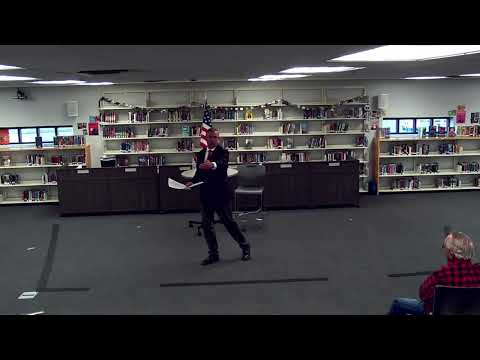
Interim superintendent candidate Brett Dahl emphasizes consistent leadership, new writing curriculum and facility funding at HUSD forum
Summary
At a public forum hosted by the Humboldt Unified School District governing board, interim superintendent candidate Brett Dahl outlined a vision focused on consistency, student learning, a districtwide writing curriculum and a persistent approach to facilities funding, while addressing teacher retention, data use and technology/AI guidance.
Interim superintendent candidate Brett Dahl told a Humboldt Unified School District public forum that he wants to provide long-term continuity for the district and focus district work on student learning, consistent curriculum and persistent efforts to secure facility funding.
Dahl, introduced by facilitator Danny Brown, described his leadership goal as creating “a destination district that’s known for its culture of achievement” and emphasized that a district vision must be built with broad stakeholder input rather than imposed top-down. “A vision should be a stakeholder commitment,” Dahl said.
Why it matters: The governing board convened the forum so the community could hear Dahl’s leadership approach while the board decides on superintendent staffing. Dahl framed his priorities around classroom learning, districtwide alignment and addressing aging facilities — topics that determine resource allocation, staffing and long-term planning for Prescott Valley and other communities served by HUSD.
Top priorities and curriculum work Dahl listed three persistent priorities: a shift “from a focus on teaching to a focus on learning,” building collaborative trust across the district, and aligning resources to instructional needs. He said a districtwide writing curriculum is already under way: Diane Salinger is leading a writing-curriculum team that has sought teacher feedback and is working toward a rollout in December–January.
Dahl said the district currently lacks a unified K–8 writing curriculum and that the absence produces uneven student experiences by school, because some schools rely on locally funded programs while others cannot. “We have to put people in a position to do the work that we’re asking of them,” he said.
Facilities and funding Dahl called facilities a pressing problem and described recent, ongoing efforts to secure state grants. He said purchasing director Jeanette Arntzen ran a report showing the district received about $19,000,000 in building renewal grants (PRGs/BRGs) from the School Facilities Division (SFD) over the last four years. Dahl described that grant success as the result of persistence but said SFD funding is not sufficient to meet all needs and noted the state’s capital-funding system is under legal scrutiny.
Dahl referenced a court ruling, saying, “In August 2025, a Maricopa County Superior Court judge ruled that the state system for funding K‑12 public school capital needs is unconstitutional,” and said that reality complicates planning for long-term facilities work. He outlined local funding sources the district uses or may use, including District Additional Assistance (DAA) funds tied to enrollment and Indian Gaming funds, and said the district is examining carry-forward targets and spending strategies to address immediate needs such as aging buses (which he said are roughly 25–27 years old) and failing systems (he cited a pressure-release issue at Lake Valley Elementary School that might force a temporary water shutoff).
Teacher recruitment, retention and professional development Dahl said attracting and retaining teachers is a local challenge tied to regional housing costs and pay competitiveness. He described steps the district has taken to support teachers: paid induction days for new hires, multiple dedicated professional-development days built into the calendar so teachers do not lose instructional time, and Project Momentum (a program that brings external expertise into the district). He said the district added two calendar days so teachers now have three professional days for collaborative learning without needing a substitute.
Data, assessment and technology Dahl described using benchmark assessments and a new platform called DNA to find learning gaps early and cautioned that assessment should guide action without being treated as personal critique. On technology and artificial intelligence, Dahl said technology must supplement — not replace — strong teaching, and recommended a measured approach for AI: a red/yellow/green framework (red = no AI; yellow = restricted use with clear parameters; green = assignments explicitly designed to use AI). He noted alignment between state online assessments and practice platforms reduces the risk that testing measures platform navigation rather than student knowledge.
Community engagement and extracurriculars Dahl emphasized listening to parents, PTOs and business partners and proposed advisory and solution teams — including a student advisory committee and cross‑district “solution teams” — to give stakeholders a regular voice. He described extracurricular activities and events such as first‑responders nights as important community engagement tools and acknowledged aging athletic infrastructure (he cited football field lights 40–50 years old) as another facilities priority.
No board action taken The forum was a candidate presentation and Q&A; the governing board did not take formal action or vote during the event.
Closing Dahl closed by summarizing his background (about 27 years in education, roughly 20 of them in HUSD), reiterating that his goal is continuity and collaboration, and encouraging community input as the governing board proceeds with its hiring process.