
Clay County approves five-year penetration testing contract and IT hardware upgrades
Get AI-powered insights, summaries, and transcripts
Sign Up Free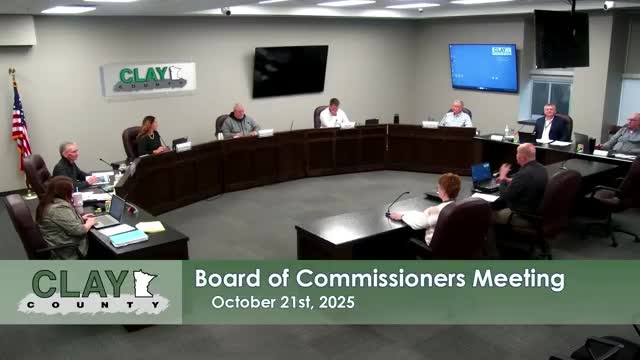
Summary
The board approved a five-year contract for annual penetration testing with CliftonLarsonAllen, a camera licensing maintenance adjustment and purchase of a new Pure Storage appliance for criminal justice data after reviewing vendor quotes and termination provisions.
Clay County commissioners on Oct. 21 approved several information-technology procurements intended to strengthen cybersecurity and upgrade storage for criminal-justice systems.
IT Director Rory (last name not provided) and Jocelyn recommended CliftonLarsonAllen (CLA) for annual penetration testing, vulnerability assessment and retesting under a five-year engagement budgeted at $25,000 per year. Commissioners asked about an early-termination option; county counsel later confirmed the contract contains a termination clause: cancellation in months 1'12 requires payment equal to a one-year fee, and cancelling after 12 months carries a 20% one-year-fee termination charge. The board approved the recommendation with the understanding the county attorney will review and finalize contract language.
IT staff also reported a renewal bill for security camera licensing and maintenance that rose because two recently completed projects added roughly 90 cameras; the current renewal was $15,798.38. IT requested an additional $6,500 to cover the higher maintenance and anticipated camera and server additions; commissioners approved reallocating existing 2026 technology professional services funds to cover the increase.
Finally, the board approved purchase of a new electronic storage appliance for criminal justice staff (law enforcement, attorneys, corrections and juvenile detention). IT received three quotes under state contract; the board authorized buying the Pure Storage option from SHI at $95,055 (lowest quoted price). Funding will come from prior internal-service allocations and the technology services budget.
Commissioners and staff noted the purchases address separation requirements for criminal-justice data, legacy hardware end-of-life concerns and state audit/compliance expectations.