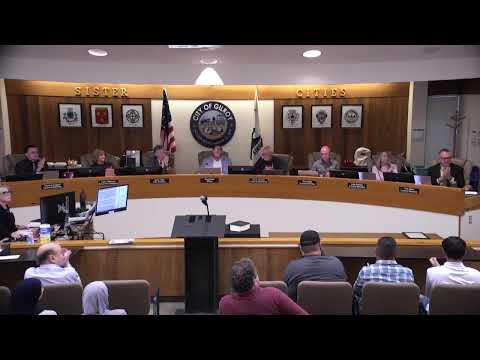
Council reopens debate on electronic billboards on SR‑101; majority asks staff to continue study, not decide now
Loading...
Summary
An applicant asked the city to amend the zoning code to allow off‑site electronic billboards along State Route 101. Councilmembers were split; a majority directed staff to continue research and to return with refined zoning language, CEQA review and potential planning‑commission review rather than approve or deny the change tonight.
Community Development staff presented a request from an applicant to amend Gilroy’s zoning ordinance to permit off‑site electronic billboards (digital billboards) along State Route 101. The council heard the history of a similar application in 2023 that had been denied by the planning commission and council and then discussed whether to put staff resources into developing a new ordinance and environmental review.
Staff presentation and prior actions
Melissa Durkin explained the application seeks to allow off‑site electronic advertising, a substantial change from existing city rules that prohibit off‑site signage and electronic billboards. The city’s prior consideration (Z‑1804) in 2023 included an initial study/mitigated negative declaration and resulted in a planning commission denial (4–3) and a council denial (4–3). Durkin said if council wishes to revisit the question, staff and the city attorney advised that any prior CEQA document would need review and possible readoption or revision.
Policy issues the council discussed
The council and public discussed ten core issues staff identified: whether off‑site advertising should be permitted at all; potential light and aesthetic impacts (including proximity to sensitive receptors and Lick Observatory on Mount Hamilton); whether signs should be permitted on public or private property; the form of an agreement between the city and any sign operator; compliance and enforcement mechanisms; the number and spacing of signs; permitted locations and land‑use designations; sign height and area limits; and whether to require a community‑benefit component (for example, a guaranteed community message loop for local events).
Public comment was divided. Supporters — including several local business owners and the applicant, Mike Conrado — said electronic signs can provide a free city message panel and generate revenue shared with the city while attracting customers to local businesses. Opponents — including long‑time residents and community groups — raised concerns about visual clutter, light pollution, limited demonstrated demand from local advertisers, and the change to the city’s 2040 General Plan objectives for the visual environment.
Council direction
After discussion, councilmembers broadly agreed the issue requires more policy work rather than a decision on the applicant’s pending zoning amendment. Two councilmembers said they would not pursue the change now and preferred waiting for the incoming economic development director and city administrator; a majority of council (five members) directed staff to continue work on an ordinance and bring back detailed recommendations, including consultation with Caltrans about location restrictions, updated CEQA review if necessary, and consideration of planning commission review as part of the process.
Durkin told council staff will prepare the next steps, which could include: refined draft ordinance language, a revised CEQA analysis, model agreements (development or operating agreement) that would map revenue/benefit and content rules, and recommended procedures for location, spacing, height and community‑benefit requirements. Durkin noted the draft the applicant previously proposed included limits, such as a maximum of two signs, a 75‑foot maximum height and limits on brightness and animated text.
Quotes
“The city council would need to adopt a new section regulating billboard signs and would also need to review the initial study/mitigated negative declaration again if council wishes to move forward,” Melissa Durkin said.
Ending
Council did not vote on the ordinance tonight. Staff was directed to continue preparing ordinance language, environmental analysis and proposed agreement structures and to return for additional council policy direction.