Get Full Government Meeting Transcripts, Videos, & Alerts Forever!
Get email alerts on the Atv Utv On City Streets topic
No spam. Unsubscribe anytime.
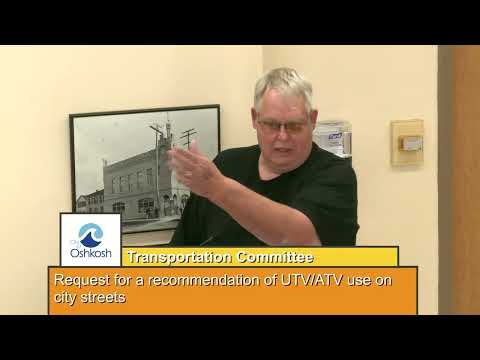
Oshkosh committee pauses action on allowing ATVs and UTVs on city streets after large public response
Summary
The Transportation Committee discussed survey results and public testimony on whether to permit ATVs and UTVs on Oshkosh city streets. After extended public comment and questions from police and staff, no motion was made and the proposal died for lack of a second; staff will continue to provide information for future consideration.
The Oshkosh Transportation Committee debated whether to recommend allowing all-terrain vehicles (ATVs) and utility terrain vehicles (UTVs) on city streets after a public survey and several hours of testimony on Oct. 13.
Committee members heard that about 1,400 people responded to a city survey: roughly 55 percent opposed allowing ATVs/UTVs on city streets, about 40 percent favored allowing them, and the remainder were neutral. Jim Collins, transportation staff, summarized the survey and supplemental materials and said the city had just closed the poll and distributed the results to the committee.
Why it matters: The committee’s recommendation would go to the Oshkosh Common Council for possible adoption; council may accept or reject the committee recommendation. Advocates said allowing ATVs/UTVs could increase downtown visits and local fundraising rides; opponents cited safety, enforcement, noise and equity concerns.
Supporters described controlled, lawful use in neighboring jurisdictions and large, well-run group rides. “We had 71 machines, over 100 miles, stretched nearly 2 miles long, without incident,” said Dave Schmidt, president of Fox River Wheelers, who urged a positive recommendation and requested a copy of the survey results as public record. Other public speakers emphasized vehicle safety features such as roll cages, headlights and seat belts and noted that many owners already carry insurance.
Law enforcement and staff raised enforcement and legal concerns. The city’s chief of police told the committee the statewide data are limited and that “from a public safety perspective, I really don't have any — I can't tell you that they're going to be harmful.” He said policing and staffing to enforce a new local ordinance could be difficult and that combining new allowances for ATVs/UTVs with other recent mobility changes (for example, e-bikes) could add complexity. He also explained a legal distinction: ATVs/UTVs are regulated by the Wisconsin Department of Natural Resources (DNR), not the Department of Transportation; as a result, penalties for operating under the influence follow DNR procedures and do not automatically produce the same driver-license suspensions that state OWI statute provides for motor vehicles.
Committee members asked about local impacts and whether Oshkosh would be the first city of its size in the state to permit these vehicles on city streets; staff said only a few smaller cities had adopted such allowances and that a city Oshkosh’s size would be relatively unusual. Multiple committee members cited the survey result (majority opposed among respondents) and the lack of mature data as reasons to be cautious.
Outcome and next steps: No motion was made (the item was not moved and lacked a second), so the item died for lack of motion at this meeting. Staff indicated the survey results are available online via the city Transportation Committee materials and will be provided to requesters; proponents also requested a formal copy. The subject remains eligible to return to the committee or to be brought by a council member for future ordinance consideration.
Community context: Public testimony included representatives of local ATV/UTV clubs, adjacent residents concerned about safety and noise, and users who said allowing on-street travel would reduce the need to trailer vehicles to nearby trail systems. Several residents pushed back on opening streets because of narrow city roadways and limited enforcement capacity.
The transcript of public comment and staff remarks will be part of the record when the city council considers any future recommendation.