Get Full Government Meeting Transcripts, Videos, & Alerts Forever!
Get email alerts on the Budget Workshop topic
No spam. Unsubscribe anytime.
Moses Lake budget workshop: fire and ambulance reductions, engineering and public works staffing and program shifts
Summary
Council reviewed departmental budget highlights for 2026 including a reduced fire budget as SAFER grant funding ends, ambulance revenue uncertainty tied to Medicare, engineering staffing and project shifts, and proposed operations funding adjustments across water and other utilities.
Council members reviewed the second agenda item, Budget Workshop No. 3, where department leaders presented 2026 budget highlights and asked for direction on several staffing and program decisions.
Fire and ambulance: Chief Perillo of the Moses Lake Fire Department told the council that the 2026 fire budget reflects restructuring and the scheduled end of SAFER grant funding. "The 2026 budget reflects the conclusion of the funding for the 9 SAFER grant positions on 07/30/2026 resulting in an approximately $500,000 loss in federal funds to help offset the added cost," Perillo said. He described a departmental reorganization that transferred portions of the fire marshal duties to the building official and said the reorganization reduced wages and benefits by 16.5% from 2025 to 2026 while increasing training and services to close identified gaps. Overall, Perillo said the proposed fire budget is about 8.9% lower than 2025.
Perillo also discussed ambulance operations. He said ambulance revenues face uncertainty because of changes in Medicare reimbursement and the potential loss of a rural bonus in federal reimbursement. The department’s ambulance fund shows a budget reduction of roughly 2.5% from 2025 to 2026, with a 65% reduction in cost‑recovery estimated because of those reimbursement uncertainties.
Engineering and capital project staffing: Engineering director Lee told the council the division completed a six‑year capital improvement plan and has 9 active projects in design and additional projects slated for bid. The proposed engineering operating budget shows a year‑over‑year decrease of about 19.5% driven in part by moving some model updates and recurring work into the water and wastewater operational funds and by reallocating project engineering time into capital funds where engineers bill directly to projects. Lee said the department reorganized development review functions and will shift a staff position (Corey Davis) into construction management.
Streets and stormwater: Street division manager Brad Mitchell described operational savings after bringing signal testing and conflict monitoring in house and noted sign‑management improvements and sign recycling that lowered unit costs. He also described a program to rent an asphalt trailer for pothole repair to reduce costs. The street maintenance general fund shows reductions from 2025 related to one‑time truck purchases in the prior year.
Stormwater staff described ongoing compliance work and a near‑complete stormwater general plan; the division requested one new outreach/education coordinator position that would be partially funded by recurring Ecology capacity grant dollars. Staff said the Ecology capacity grants have been a steady, annual source and can be used for staffing and compliance activities.
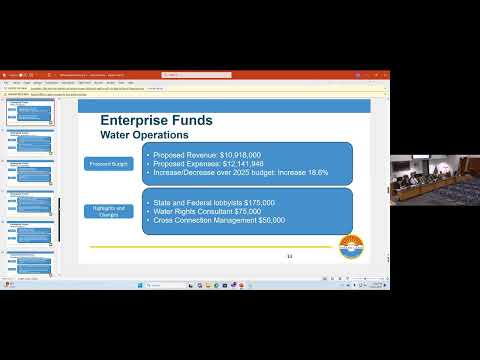
Water and other utility budgets: Water division staff summarized operational accomplishments (meter replacements, hydrant and valve inspections) and explained a modest shift of some lobbying and water‑rights consultant expenses into the water budget because the work is primarily water‑related. Water proposed revenues were shown at about $10.9 million with proposed expenses near $12.1 million, an increase driven by operating costs and consultant activity.
Questions and next steps: Council members probed specific line items and asked for clearer year‑to‑date actuals in the final budget packet; staff said they will provide September year‑to‑date numbers in the final budget. Council requested follow‑up on: how ambulance billing and coding affect reimbursements; alternatives for large irrigation meters in the water rate study; and scenario modeling of bill impacts for typical customers using the FCS rate calculator. Staff agreed to return with additional scenarios and more granular financial comparisons before formal adoption of rates and the final 2026 budget.
Ending: The council asked staff to provide additional bill examples, return actuals through September for each fund, and to present middle‑path rate and budget scenarios at the next meeting.