Get Full Government Meeting Transcripts, Videos, & Alerts Forever!
Get email alerts on the Transportation topic
No spam. Unsubscribe anytime.
Bloomington council grants municipal consent for MnDOT I‑494 Project 2; local cost share items outlined
Summary
Council approved MnDOT’s request for municipal consent for Phase 2 of the I‑494 corridor work and heard a summary of the city’s expected local cost share for sidewalks, signals, lighting and contingency items.
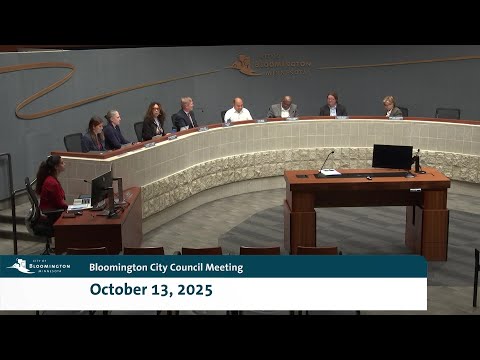
The Bloomington City Council on Monday adopted a resolution granting municipal consent for MnDOT’s I‑494 Project 2, clearing a statutory step required when a state highway project alters access, acquires right‑of‑way, or changes capacity within a municipality.
Council approved the municipal‑consent resolution on a 5–0 vote after MnDOT staff presented the project scope and a summary of anticipated local costs related to pedestrian, bicycle and local roadway connections. MnDOT said Phase 2 will fill gaps left by Phase 1, reconstruct portions of County Road 81/35W/494 interchanges, add express‑lane facilities, and include multi‑modal elements such as sidewalks, trails and street lighting.
MnDOT and city staff outlined an estimated local cost participation for Bloomington that was presented during the hearing. Items listed by MnDOT or city staff included:
- About $100,000 for local sidewalks/trail connections that lie outside MnDOT right‑of‑way; - An estimated $750,000 for signal replacements at France Avenue and 80th Street; - Street‑lighting costs along 80th Street (staff presented options for light counts and associated costs); and - An additional $160,000 estimated for contingencies and engineering to support the local construction work.
MnDOT described a multi‑year staging plan intended to retain three travel lanes on I‑494 through construction where feasible and to deploy a “toolbox” of temporary traffic‑management measures — for example, temporary signals, temporary striping or short‑term lane additions on local roads — to respond to localized congestion during construction. MnDOT staff said the project’s major utility relocations would begin in 2027 with mainline construction anticipated in 2028–2030.
Council members asked about local mitigation, neighborhood effects and responsibilities for traffic and construction staging; MnDOT and city staff said they would continue to coordinate and monitor local streets and implement mitigation tools from their toolbox as needed.
Ending — Next steps Council’s municipal‑consent vote allows MnDOT to proceed with the state’s procurement and construction schedule for Project 2. MnDOT and city staff said they will continue to brief council and neighborhood representatives as design and construction progress.