Get Full Government Meeting Transcripts, Videos, & Alerts Forever!
Get email alerts on the Police Certification And Discipline topic
No spam. Unsubscribe anytime.
POST panel outlines decertification process, timelines and reporting duties under SB 2
Summary
Staff from the Peace Officer Standards and Training (POST) Professional Conduct bureaus answered questions about how decertification works under SB 2, including reporting deadlines, temporary suspensions, appeals and data the agency publishes about investigations.
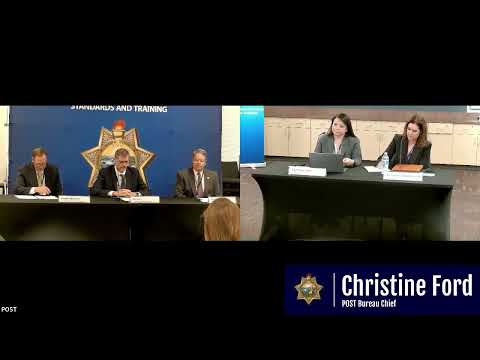
Representatives of the California Peace Officer Standards and Training (POST) held a virtual Q&A on the agency’s decertification process under Senate Bill 2, answering pre-submitted and live questions about reporting deadlines, temporary suspensions, appeals and public data.
Brad Hoflander, representing POST’s Professional Conduct Northern Bureau, told attendees that "POCAD itself does not have the authority to decertify an officer." He explained that law-enforcement consultants in POST’s Professional Conduct bureaus review investigations and make recommendations; the POST commission has the final authority to revoke a certificate.
Why it matters: Decertification removes an officer’s state certificate to serve as a peace officer in California, a step that is legally separate from an employer’s disciplinary or arbitration decisions. POST staff emphasized that actions taken by an employer — including reinstatement through arbitration — do not automatically prevent POST from pursuing certification action.
Most common allegations and caseload timing
Jim Sasso of POST’s Central Bureau said the agency’s leading grounds for certification actions are crimes that violate the law and dishonesty. He said POST’s process differs from employer discipline: "Post has 3 years from the date of the allegation to complete its case, but post doesn't take that long," and that the agency’s current average review time is about four to six months for cases that proceed to the commission. Hoflander said cases that will not move forward can often be completed in one to two months.
POST staff said investigators benefit when agencies submit a complete packet — criminal reports, exhibits and any officer appeals — and keep their Mark43 contact information current to avoid delays.
Reporting duties and timelines
Panelists clarified statutory reporting deadlines tied to SB 2: agencies must report an allegation of serious misconduct to POST within 10 days of receiving the allegation and must report again within 10 days after a final disposition if the investigation determines serious misconduct occurred.
Immediate temporary suspension and interim steps
Panelists described POST’s immediate temporary suspension (ITS) power when investigators identify a public-safety risk. Daryl Elliott of the Southern Bureau said ITS is used when POST believes an officer poses an immediate threat; such cases are prioritized and monitored closely while internal or criminal proceedings continue.
Data, public complaints and triage
Michelle Wyler and Sarah Wallace described POST’s data warehouse and intake processes. Wallace, bureau chief for intake and disposition, said this year POST had received roughly 1,000 public-complaint entries (each entry generally refers to a single allegation against one officer). She said POST receives a wide range of submissions, triages them for allegations of serious misconduct and refers relevant matters to professional conduct bureaus.
Staff noted that across roughly 40,000 allegations POST receives, the portion resulting in sustained findings and POST action is relatively small — staff estimated sustained findings at about 2–3% of reports. Daryl Elliott said that to date POST had held five hearings before the board and commission, involving 20 individuals; outcomes reported were 12 revocations, four settlements, one voluntary surrender, two no-actions and one suspension.
Appeals, hearings and final decisions
The panel outlined the procedural path for contested cases: after POST’s professional conduct bureau completes its review it notifies the officer, who has 30 days to request an appeal and a public hearing before the advisory board. The board makes a recommendation to the commission, and the commission makes the final decision. If the commission issues an adverse certification action, the officer may appeal to an administrative law judge and, afterward, seek judicial review in California Superior Court via writ of mandate.
On voluntary surrenders, POST staff said a voluntary surrender generally precludes a public hearing; however, if POST has completed its investigation before surrender, POST will post a record explaining the allegations and findings.
Cooperation, subpoenas and non‑employees
POST lawyers and staff discussed cooperation requirements. Chris Becker, legal department, said failure to cooperate while employed as a peace officer can itself be a basis for serious misconduct under Penal Code section 13510.8 and that POST has administrative subpoena and deposition authority under Government Code section 11180 to pursue testimony from former officers in some circumstances.
Practical guidance for officers and agencies
Speakers recommended that agencies notify officers when a report is submitted to POST, though they acknowledged no statutory mandate requires employers to notify the officer. Staff encouraged officers to keep their POST Pass address and contact information current so POST can send certified and regular mail about temporary suspensions and other actions. POST staff noted officers may request their POST records (POST Form 2-366) via a notarized submission through GovQA.
Training and outreach
Panelists said POST offers trainings for agencies on SB 2 and use of Mark43; one Mark43 training was scheduled for November 5. They also said POST is preparing additional data releases from its warehouse and is open to agency requests for in-person SB 2 training.
Closing
Panelists reiterated that certification actions are separate from employment discipline, described how POST triages a large volume of allegations, and encouraged agencies to provide thorough investigative packets to speed reviews. The session was recorded and will be posted on POST’s website.