Get Full Government Meeting Transcripts, Videos, & Alerts Forever!
Get email alerts on the Child Protection topic
No spam. Unsubscribe anytime.
Child protection multidisciplinary team reports sustained collaboration, seeks tribal and mental‑health members
Summary
Beltrami County's Multidisciplinary Child Protection Team (MCT) described decades of continuous operation, current focus on case consultation and review of fatalities/near‑fatalities, and plans to add tribal representatives and a mental‑health professional to the team.
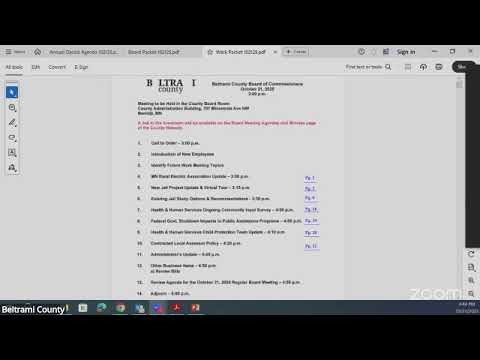
Beltrami County social‑services leaders on Tuesday described the work of the county's Multidisciplinary Child Protection Team (MCT), emphasizing long‑term continuity, case consultation and mortality review, and plans to expand membership to improve child safety outcomes.
Social‑services Division Director Jeff Flynn introduced Program Manager Carissa Golden and Hayden Meyer from the County Attorney's Office, who outlined the MCT's functions: cross‑disciplinary case review, resource identification, education for team members and the community, and state‑required child mortality and near‑fatality reviews. "The purpose of the child protection team is to bring together many professionals from across our community that have expertise in some area of child abuse, child protection, prosecution of crimes against children, chemical dependency, mental health," Golden said.
History and performance: Team members noted Beltrami County established an MCT soon after state statute required county teams in the late 1970s and has met continuously since 1977. Hayden Meyer cited Minnesota Statute 260E.02 as the statutory basis for the team and described statutory changes that expanded the committee's scope to include trafficking‑risk youth and forensic‑interview centers.
Membership gaps and next steps: Presenters said the team would benefit from more consistent tribal representation and from adding a dedicated mental‑health professional. Golden said she is preparing an orientation packet for new members and plans training in November to strengthen the team. Commissioners asked for future statistics on cases and placements; staff said they would provide placement‑trend data and examples of cases where family assessments helped keep children safely at home.
Why it matters: Team members said early multi‑disciplinary consultation reduces risk of missed signs and improves safety planning; staff noted placement numbers have declined in recent years as the department has used family assessments and case management to pursue in‑home safety solutions where appropriate.
No board action was required; the presentation served as an informational update and staff will return with statistics and further proposals on membership and training.